
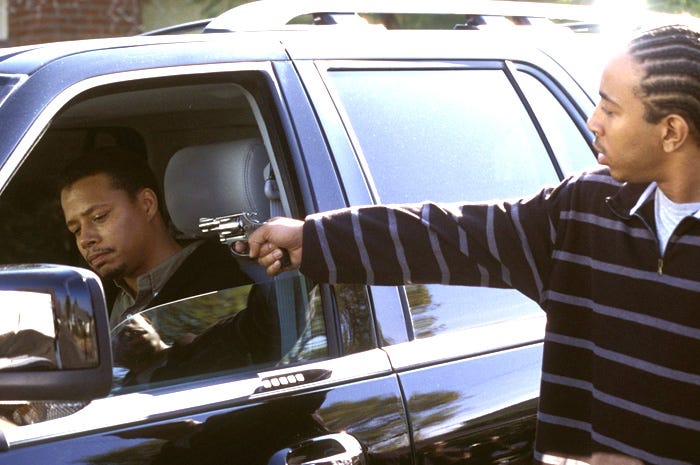
It’s hard to remember now, given its infamy as one of the worst films ever to win the Best Picture Oscar, that Paul Haggis’s Crash received considerable praise from many American film critics upon its release. The New Yorker’s David Denby wrote that “apart from a few brave scenes in Spike Lee’s work, Crash is the first movie I know of to acknowledge not only that the intolerant are also human but, further, that something like white fear of black street crime, or black fear of white cops, isn’t always irrational.” Roger Ebert championed the film for its structure of “telling parables in which the characters learn the lessons they have earned by their behavior… and are better people because of what has happened to them.” He would later name it his favorite film of 2005.
But one critic may have been the most hyperbolic of all, writing that “Crash is this generation’s The Night of the Hunter: the beginning and the end are weak, but everything in between is an American masterpiece.” These are some of the most embarrassing words ever written by a film critic.
Unfortunately, that film critic was me.
I was 15 at the time, closing out my freshman year of high school. I kept a blog which (mercifully) has been deleted from the recesses of the internet where I would write about film and whatever else came to my mind that week, including that review. I wrote about Crash again in another (mercifully deleted) MySpace post-Oscar recap, calling it “Chekhovian” for its establishment of a gun in the first act that gets fired by the end. Looking back at these early cave drawings, I’m more embarrassed by the comparisons than my praise for the film: Chekhov is one of my favorite writers of all time, and The Night of the Hunter one of many films I have called the GOAT at one time or another. Both should be spared the indignity of being mentioned alongside Crash in any way.
The critics who raved over Crash have no excuse—especially Denby, whose invocation of Spike Lee belies that in 1989, he was one of the many critics who implied that Do the Right Thing would cause Black audiences to riot. But these raves are one thing coming from professionals who’ve seen thousands of movies; it’s another coming from high schoolers who’ve seen comparatively fewer films. Interrogating my reaction to Crash means interrogating why so many of my friends felt the same way.
Growing up in LA, my peers and I didn’t experience racism—not because we were White, but because we were so blinkered by our privilege that if and when micro-aggressions took place around us, we weren’t trained to recognize them. Anti-racism and critical race theory were not zeitgeist concepts, and we were years away from #BlackLivesMatter. What we learned of racism occurred primarily in history textbooks, studying stories that conservatives want to rip out of them today.
I’m grateful to have learned about slavery, Jim Crow and the Civil Rights movement as a middle schooler. Every student should learn about the bravery of Ruby Bridges, the Little Rock Nine and John Lewis, who stood up to racists like Orval Faubus and George Wallace. But learning about this only takes you so far. If your image of racism is just Faubus, Wallace, and others like them, you don’t realize just how exceptional they are. The vast majority of racists dress their prejudice in code to add a thin vernier of palatability. Ronald Reagan didn’t explicitly say Black women were freeloaders mooching of the government: he called them Welfare Queens.” He disguised his racism in such a way that you might mistake it for a debate over policy instead of a perpetuation of the “Blacks just want free stuff” stereotype that began during Reconstruction. All this brings us back to Crash, a film where every character expresses their prejudice so bluntly that they, and their behaviors, barely resemble anything in real life.
Insofar as I can praise Crash, it occasionally makes its arguments well enough to show glimpses of the film it might have been in the hands of someone more capable of subtlety than Haggis. Ludacris, whose performance as Anthony is hands-down the best in the film, is introduced with a monologue about how Sandra Bullock’s Jean grabs her husband’s (Brendan Fraser) arm closer as he and his partner-in-crime Peter (Larenz Tate) pass by. It’s on-the-nose, but it’s about as good as the film gets:
“Look around you, man. You couldn’t find a whiter, safer or better lit part of this city…But yet this White woman sees two Black guys who look like UCLA students strolling down the sidewalk and her reaction is blind fear? I mean look at us, dog! Are we dressed like gangbangers?...If anyone should be scared around here, it’s us!”
However, immediately afterwards, Ludacris and Tate carjack Bullock and Fraser, undermining the speech by affirming that Bullock was right to be afraid. This is the first of the many manufactured conflicts comprising the film, as Haggis smashes the characters together like pinballs to re-enforce his larger points, even if he has to defy dramatic logic in order to do so.
One of the film’s more infamous contrivances comes when Officer Ryan (Matt Dillon) pulls over Christine and Cameron (Thandiwe Newton and Terence Howard) and sexually assaults Newton. Christine and Cameron replay these events in agonizing back-and-forth, as she accuses him of not standing up for her and he accuses her of being aggressive towards Ryan and affirming the “Black women are hyper-sexual” stereotype dating back even further than Reconstruction. This devolves into a discussion of how neither knows what it’s really like to be Black:
Cameron: Maybe I should have let them arrest your ass! Sooner or later you gotta find out what it’s really like to be Black!
Christine: Fuck you, man, like you know! Because the closest you ever came to being Black was watching The Cosby Show!
Cameron: Yeah, well at least I wasn’t watching it with the rest of the equestrian team!
Less believable than this dialogue is the resolution of Ryan’s arc, in which he saves Christine from a burning vehicle. As a 15-year-old, I was on the edge of my seat watching this scene; as an adult, it plays like a Very Special Episode of The Perils of Pauline. The scene reveals that Christine has no agency of her own: rather, she is a prop for Ryan to both demonstrate his racism and then overcome it. There’s even a shot where he pulls her dress down to cover her waist before removing her from the car. As Susan Collins would say, “he’s learned his lesson.”
The same can’t be said for Officer Hansen (Ryan Philippe), who the film initially establishes as “the good one” who understands that racism is bad, but does no self-interrogation to ask how he might be a problem too. He works with Ryan until his disgust over Christine’s harassment spurs him to seek another partner. Later, he pulls over Cameron (again!) after another Ludacris carjacking. With several LAPD officers threatening Cameron, Hansen comes in to diffuse the tension. Although he empathizes with him, Hansen says, “these guys want to shoot you and they’ll be completely justified!” – as if a Black man can’t understand how dangerous cops are until a White person explains it to them. Just as Ryan’s rescue of Christine isn’t about Christine, Hansen’s de-escalation with Cameron isn’t about Cameron; it’s a red herring designed to keep the audience thinking that he’s “the good one” – until the end of the second act, when he kills Peter after he reaches for a statue of St. Christopher and Hansen mistakes it for a gun.
So why did my friends and I love this film so much?
There is a cynical brilliance to Crash in that by contorting every scene to be about “racism bad” it convinces audiences that they’re watching something capital-I Important, especially young audiences who aren’t as attuned to these tricks. We were the perfect audience for Crash: teenage liberals in a blue state figuring out who we were and how we related to a political scene defined by the ultra-conservative Bush Administration who, when the film came out, seemed unstoppable, and by the time it won Best Picture had begun a downward slide that would culminate with America doing the unthinkable and electing a Black President. We wanted to stand up for the right thing, and since the wrong thing is racism, we figured that not being like those people was enough. On top of that, Crash is skillfully made– well-edited and well-shot, and well-acted enough given what everyone has to work with – that if you haven’t seen any of the films it mimics, from Short Cuts to Do the Right Thing, it’s like watching Citizen Kane. If you’d taken a poll on my campus, most of us would have voted for Crash. And even I was happy when it won – although I would’ve voted for the other film.
So what did we think of Brokeback Mountain?
I hate to say “it was a different time,” but if you weren’t around in 2005, you don’t understand how pervasive—and acceptable—homophobia was. The anti-gay marriage movement had arguably swung the 2004 election to Bush, gays and lesbians had almost no representation in Congress, and homophobic jokes were de rigueur: just watch any episode of Family Guy from that time, or any of the bro comedies whose “no homo” jokes aged like milk. If Tracy Morgan had said “if my son was gay, I’d shoot him” in 2005 instead of 2011, he would never have had to apologize.
Brokeback Mountain was one of the only films with fully dimensional gay characters to have any cultural status in the early-to-mid-2000s. LGBT+ movies almost always flew under the radar of critics back then, and it would be years before some of the era’s cult classics, like Jamie Babbitt’s But I’m a Cheerleader, finally got the recognition they deserved. Brokeback didn’t just get good reviews and awards, it made money, and with that money came cultural ubiquity. Even if you hadn’t seen the film, if you heard that iconic guitar riff from the score or the words “I wish I knew how to quit you,” you knew exactly what they referred to.
I saw Brokeback during winter break of my sophomore year and left the theatre staggered. To this day, I still remember how I felt when I saw Heath Ledger’s Ennis Del Mar breakdown in the alley at the end of the film’s first act. It wasn’t just about saying goodbye to Jake Gyllenhaal’s Jack Twist; it was the cry of anguish that comes from living in the closet. And while I understand the criticisms of the film’s ending, given the history of the “one dead gay” trope in LGBT+ cinema, I still think it’s the ending the film needed to have.[1]
I should not have been shocked by the fact that my peers largely hated Brokeback Mountain, but I was. I attended a very progressive high school which celebrated Coming Out Day in October and had a strong gay-straight alliance. Unfortunately, that didn’t mean students wanted to see gay life depicted on screen. It was not uncommon to hear teenagers call Brokeback something along the lines of “two guys poking each other in the butt,” as one of the guys I carpooled with called it, or hearing people say it was boring, pious, or some combination of the above. Even several adults I knew damned it with faint praise, giving it a gold star for being about an “Important Topic” without actually wrestling with why it was important in the first place. Perhaps some of them did not want to look at what the film had to say about them – at least three people I knew who dismissed it would come out as gay years later. Even though I knew a few people who liked it, I don’t think I’ve ever felt so totally isolated in liking a film before or since.
This schoolyard debate was a mirror of what happened within the Academy. Homophobia was not the only reason Brokeback Mountain lost Best Picture. Lionsgate shoveled buckets of money into a Weinstein-level awards campaign for Crash that Focus simply didn’t for Brokeback. (My parents, who were union members, never got any Brokeback DVDs or scripts but got tons for Crash.) But hearing old folks like Ernest Borgnine say they wouldn’t even see the film spoke to deeper divisions that money couldn’t account for. A journalist friend of mine knew Brokeback was doomed after he polled 50 voters and with one exception, a gay filmmaker who called it “his duty” to vote for it, everyone else voted for Crash. The Monday after the awards, none of my classmates even mentioned Brokeback. They were too excited that Crash won. I was too.
20 years later, I’m less disappointed by their not liking Brokeback than I am by the assumption I made that because I grew up surrounded by liberals, these liberals would accept all films about social issues. But, like the Academy members, these liberals wanted to learn about a “serious” issue by preserving their superficial sense of “at least I’m not like them!” while relegating films from a non-heteronormative point of view as “less than.” If the Crash upset proved anything, it’s that homophobia is bipartisan. So is immaturity.
[1] In my defense, I wouldn’t learn this was a stereotype until I saw The Celluloid Closet senior year of college. If I’d known about it then, I’d probably still defend it, but not without a serious debate.