
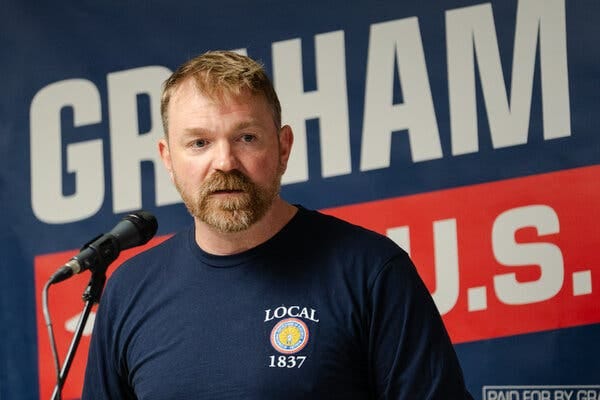
The circular firing squad consuming the Democratic Party since the start of Trump’s second term intensified after last weekend’s revelations that Graham Platner, the presumptive Democratic nominee for the Senate seat in Maine against Republican Susan Collins, was sexting multiple women while married. Platner’s wife, Amy Gertner, flagged the sexts to then-campaign political director Genevieve McDonald last summer, with the addendum that she and her husband were in couples counseling over it.
The sexts are just the latest in a series of scandals for Platner. Although his backstory of soldier to oyster farmer to fiery populist candidate feels like a Frank Capra film come to life, everything that’s come out about him since—the Nazi tattoo, the obscene Reddit posts, the old news articles where he shows off his trollish nature—reveals a much darker side to him. Platner has managed to weather these scandals thanks to his D.C.-based consultants, a lack of any real challengers and influencers willing to bend over backwards for him (I’m looking at you, Pod Bros). It’s possible that they will carry him through this scandal too. But the fiasco of Platner’s candidacy sheds further light on the gender divide characterizing the Republican and Democratic parties, as well as the far left and center-left factions of the Democrats.
Republicans have been male-coded ever since Reconstruction, when opponents of racial integration created the sanitized image of the American Cowboy as a symbol of American individualism and resistance to government overreach. (Never mind that a fourth of all cowboys were Black). This continued well into the 20th and 21st centuries, when Republicans like Ronald Reagan and George W. Bush utilized cowboy imagery as part of their persona. Their presidencies—especially Reagan’s—coincided with the rise of movie stars whose conservative politics matched the “tough guy vs. the system” action movies they became famous for. Arnold Schwarzenegger, Bruce Willis, Sylvester Stallone, Clint Eastwood and Chuck Norris were modern cowboys who shot first and asked questions later. By the time of Bush’s presidency, Schwarzenegger had become Governor of California, following in the footsteps of Reagan and bringing his movie persona to the state house. In 2004, he told Democrats “don’t be economic girlie men!” At the time, I thought liberals were overreacting to a pretty tame joke. In retrospect, I understand their criticisms.
If Republicans have always been masculine-coded, Democrats have historically been feminine-coded, with their appeals to women voters, their base of Black women, and their status as the only one of the two major parties to ever nominate women for president—not to mention their positions on protecting the environment, getting rid of guns, and other issues that were derisively called “gay” when I was growing up. My friends and I witnessed this divide play out as the debate over gay marriage consumed the discourse and homophobia swelled—all Republicans had to do was say “San Francisco” and you knew they meant “gay.” Kindness and compassion were less desirable than an impulsive trigger finger. Nobody put it better than a girl from my high school who graduated a few years before me: in an editorial for our school newspaper, published shortly after 9/11, she explicitly praised George Bush as a tough cowboy and called Martin Sheen’s Jed Bartlett from The West Wing “a pussy President.”
The masculine/feminine debate faded a bit during Barack Obama’s presidency, as he was such a positive male role model that he made the Republican opposition seem weak. But following Hillary Clinton’s loss to Donald Trump, a good portion of Democratic Party operatives and voters—many of them supporters of Bernie Sanders in 2016—began looking for their own Great White Hope, a tough-talking, populist man’s man who could bring in male voters and speak to “the heartland.” If Clinton was the mom who told you to eat your vegetables before you could have dessert, these operatives wanted someone who, like Sanders, was the cool dad who promised dessert right away. They sought men who made no apologies for their masculinity and looked like they came from a casting director’s resume book.
In 2017, steelworker Randy Bryce announced his campaign against Republican House Speaker Paul Ryan in Wisconsin’s first district. Bryce, an ironworker nicknamed “The Iron Stache” who’d never run for political office before, went viral for his unconventional image and fiery populism, and raked in money. Journalists hailed him as a potential future leader of the Democratic Party. His opponent in the primary, schoolteacher Cathy Myers, warned voters of Bryce’s red flags—multiple arrests for drunk driving, driving without a license, and marijuana possession, as well as failing to meet child support payments—but Bryce clobbered her in the primary. He lost the general election by 12 points. Currently he’s running for Congress again, but his campaign doesn’t even have $10,000 cash on hand.
In 2021, Lieutenant Governor John Fetterman announced he’d run for the open Senate seat in Pennsylvania. Fetterman, who eschewed suits for hoodies and shorts and stood at 6’8, went viral for his unconventional image and fiery populism, and raked in money. Journalists hailed him as a potential future leader of the Democratic Party. His opponents in the primary, State Senator Malcolm Kenyatta and Congressman Conor Lamb, warned voters of Fetterman’s red flags—namely, chasing down a Black man with a shotgun—but Fetterman clobbered them in the primary. He won the general election by 5 points. Currently he’s every Democrat’s least favorite Democrat, and many who endorsed him back then have handed in what AOC called their “Conor Lamb apology form.”
Then in 2025, Graham Platner announced he’d challenge Susan Collins. Platner, a veteran of the Iraq War who had a beard and sported fiery populist tough talk, went viral for his unconventional image and fiery populism, and raked in money. Journalists hailed him as a potential future leader of the Democratic Party. His opponent in the primary, Maine Governor Janet Mills, warned Democrats of his red flags—like his Reddit posts about rape and the Nazi tattoo—
You know where this is going. Each time the Democrats chase a stereotypical avatar of masculinity, they wind up with a toxic man at the helm, because masculinity without kindness and compassion breeds toxicity. You would think that after Bryce and Fetterman they wouldn’t have lined up behind Platner, but they have become prisoner to the masculine/feminine coding of the two parties and ignore that chasing White men, who have not voted as a majority for a presidential candidate since LBJ, bespeaks a latent resentment towards the actual base of the party (Black women and POC) who decide the presidential nominee in the primaries. Rather than cater to a base that is overwhelmingly feminine, these candidates and their consultants rebel against it by centering Whiteness and maleness in a way it hasn’t been centered in the party since Jim Crow.
American history is filled with toxic populists like Graham Platner whose names only appear as cautionary tales in history textbooks. But some people can’t get over their addiction to these “men on horseback,” as pollster Pat Caddell called them. And when these men come, they’re not carrying an olive branch.
Joy Reid captured a major part of the problem seven years ago:
https://www.salon.com/2019/06/30/msnbcs-joy-reid-how-america-can-save-itself-from-trump-and-trumpism/
“I looked at a ton of polling and research for this book, like one of the things that came out very clearly was that the idea of economic anxiety electing Trump was completely made up and bogus. There’s no data to support it. As a matter of fact, to the extent that a white American is economically anxious, it produced either no vote at all or a vote for Hilary Clinton. Hilary Clinton is the person who economically anxious white voters voted for. Or like most poor people, white poor people don’t vote.
“People who voted for Trump may not have had a college degree, but they’re a cop or a plumber, a fireman. They’re somebody with money. They just don’t have a college degree, so the nomenclature is all wrong. But the kind of person that the data shows does vote for Trump, or did vote for Trump, or really likes him is the kind of white American who feels that they are now victimized, that racism really is directed at white people. That white Americans are becoming the minority and are being besieged and persecuted by liberals, by east coast elites, by people of color. They actually feel that affirmative action is victimizing them, that their place in America to the extent that it isn’t as economically robust as it used to be is not because of anything they’ve done wrong, it’s because immigrants are stealing, immigrants are taking their jobs, people are picking their pocket who are brown or who are Muslim. Muslims are destroying Christianity. Gays are destroying marriage. Trans people are destroying the bathrooms.
“It’s always some other group that is hurting them. And so that sense of victimization is a real feature of base conservatism and the perfect avatar for that is the guy who feels like the ultimate victim, the ultimate white. Donald Trump used to say a thing in the ’90s where he’s like, you know I think I’d be better off if I was a black. I’d be better off is I was a black because then I’d get all kinds of free stuff. I’d get affirmative action. I’d have a leg up. The blacks are better off than us. That is what the Trump voter thinks.”
It's the median voter theorem. Democratic politicians know that blacks and feminists do not have anywhere else to go. They can afford to focus all their efforts on swing voters.