
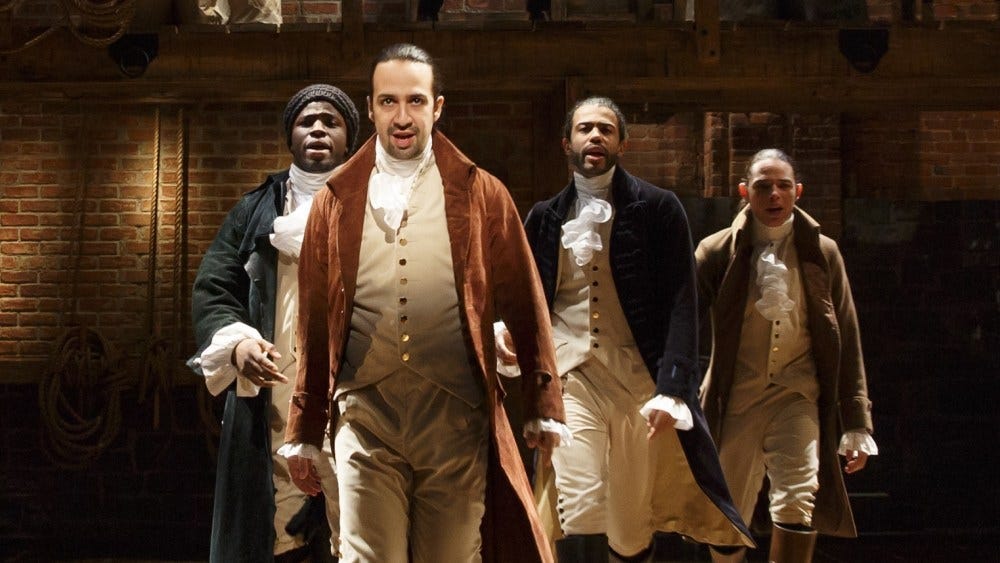
Hamilton, which opened on Broadway 10 years ago today, is still the greatest musical I’ve ever seen. When I saw it at the Public Theater in February 2015, it had been six years since I told all my friends they needed to watch the video of Lin-Manuel Miranda performing the opening number at the White House; and it had been two years since I’d been an apprentice at the Vassar Powerhouse Theater, when Miranda and director Tommy Kail staged a workshop of the first act. I didn’t get to see it there, but I did get to hang with Miranda and quote The Room, which inspired me to make this video:
In retrospect, I’m glad I didn’t see Hamilton at Vassar because I was that insufferable guy who wouldn’t shut up about it for almost all of 2015 — imagine if I’d been that guy for two whole years. Fortunately, by the time the soundtrack came out, my obsession didn’t look so unique. Harvard students would walk around the campus singing along to the songs as they listened to it on their iPhones. (Full disclosure: I was one of these students.) Pretty much every Facebook status I posed from 2015 to 2016 was about Hamilton, and I’m not ashamed of it. And yet I can’t help but feel that the cultural landscape of 2025 somehow wants me to be.
Nothing is popular forever, nor is it immune to criticism, and Miranda has been open to addressing the good faith criticisms of the work. But in the 10 years since Hamilton opened, the United States has become a meaner, more cynical place, one that the 2015 me wouldn’t have recognized, and the aesthetics of Hamilton criticism have become mainstream. And that does a disservice not just to Hamilton, but to the way we interpret art.
The initial backlash to Hamilton came from its association with President Barack Obama, and its status as the definitive artwork of his presidency. If you ever believed that Obama’s presidency led America to a post-racial moment, then Hamilton, with its powerful story of a Latino Immigrant Made Good, written in the style of music Obama himself grew up listening to, and performed by actors who would never have been cast in the roles of the White Founders before, influenced your thinking. This association meant that the initial critiques of Hamilton came from the far-left corners of the internet, who frequently criticized Barack Obama, Hillary Clinton, and mainstream liberalism.¹
Alex Nichols launched one of the first screeds with a piece in the vanity publication Current Affairs called “You Should Be Terrified That People Who Like Hamilton Run Our Country,” which ran the week of the 2016 Democratic National Convention, an event where then-nominee Hillary Clinton cited Hamilton in her acceptance speech and at which Miranda performed. Describing Hamilton as “a corporate HR department’s wet dream,” he wrote that people only thought was groundbreaking because of its music and its colorblind casting, ignoring that its “superficial diversity lets its almost entirely white audience feel good about watching it: no guilt for seeing dead white men in a positive light required.” Nichols, who hadn’t seen Hamilton, writes the essay like he’s jealous of everyone who did. His take amounts to: If only people who could afford tickets had seen it but I can’t, then why is everyone talking about it? (It should be noted that more people even at that point had seen Hamilton than have ever read an article in Current Affairs.)
Nichols’ screed was nothing compared to American Economic Liberties Project founder and Obama hater Matt Stoller, whose scathing jeremiad “The Hamilton Hustle” described the the real Alexander Hamilton as an anti-democratic, monopolistic oligarch:
“It’s [Hamilton] become a status symbol within the Democratic establishment, offering them the chastened consolation that they might still claim solidarity with the nascent American democracy of the eighteenth century that stubbornly eluded them in the present-day political scene… Our generation’s version of Hamilton adulation isn’t all that different from the version that took hold in the 1920s: it’s designed to subvert democracy by helping the professional class to associate the rise of finance with the greatness of America, instead of seeing in that financial infrastructure the seed of a dangerous authoritarian tradition.”
Stoller’s Hamilton hate is not just an extension of his racism but also his myopic worldview. Like the hedgehog in Isaiah Berlin’s “The Hedgehog and the Fox,” Stoller can only interpret things through a self-imposed dichotomy of antitrust vs. monopoly. Tying Hamilton back to the 1920s is his attempt to tie it to the economists and cabinet members whose financial policies caused the Great Depression. This makes him the worst possible person to interpret any work of art: although all art is political, a critic must, in at least some way, separate the craft of a work of art from its political message so long as the work in question isn’t propaganda.
Few, if any, of this first iteration of Hamilton critics were worth taking seriously. One of the few with any gravitas was Mumbo Jumbo novelist Ishmael Reed. His 2019 play The Haunting of Lin-Manuel Miranda parodies A Christmas Carol, with ghosts excoriating Miranda for whitewashing the Founding Fathers and ignoring Hamilton’s complicity in slavery. The play didn’t get very good reviews, but if the best way to critique a play is to write a play, then Reed deserves respect. Still, takes like these were few and far between.
Hamilton’s association with Democrats solidified further when Brandon Victor Dixon spoke directly to then-Vice President Elect Mike Pence after a November 2016 performance, asking that the incoming administration do right by “the diverse America” he and the cast represented. Now a symbol of The Resistance, Hamilton received a Kennedy Center Honor in 2018. But by the time Trump left office in 2021, criticism that had once been based on “this art doesn’t meet all my priors” had evolved into “this art is cringe,” a reaction against any art which favors optimism over irony (even an optimism tempered by defeat, as in the case of Hamilton), especially if it became popular under the Obama presidency.
A 2021 Vox essay called “Why so much Obama-era pop culture feels so cringe now” by Constance Grady analyzed how Miranda’s efforts with the Democratic Party and nominee Hillary Clinton in 2016 gave his magnum opus, along with Parks and Rec and Harry Potter, an “embarrassing earnestness,” continuing:
“All are media that tends to celebrate people who work through the grind of bureaucracy to make their great achievements; media much venerated for their identity politics of representation; media with a firm but vague political identity of liberal centrism.”
Vulture’s 2024 series of articles on “Obamacore,” the key works of pop culture from the Obama era, further elaborated on the conflation of Hamilton and other works of art from what writer Nate Jones called an “earnest, optimistic, energized, celeb-obsessed, self-conscious, cringeworthy time.” Although the critics who collaborated with Jones on this series praised Hamilton and other entries on their list, their praise felt backhanded at best, as if they were saying “wow, remember when we all believed things would turn out OK? What were we thinking?”
It didn’t help matters that Lin-Manuel Miranda’s overexposure through various projects fueled a familiarity-breeds-contempt backlash. In 2021, Buzzfeed’s Meha Razdan wrote an essay called “How Lin-Manuel Miranda Went from Cool to Corny,” arguing that a combination of overexposure, taking on numerous projects of varying quality and the rise and fall that comes with building “your brand…so squarely under the flags of representation and optimism in the Diversity of the USA.”
Yes, Miranda may have taken on one too many Disney projects. Yes, we may all feel disappointed that progress didn’t take the upward trajectory we thought it would. And yes, it’s become clear over the past few years that colorblind casting, which Hamilton took mainstream, is not a one-size-fits-all solution to addresses the inequalities of theater. But it’s wrong to take out these feelings on Hamilton, or any other work of art that we could write off as “cringe.” Characterizing Hamilton as a cringe relic may have led to some very funny TikToks, but it’s not great shorthand for understanding why it had the impact it did: It really is that good.
Miranda’s decision to marry rap and hip-hop with musical theater transformed Hamilton into a microcosm of the history of both art forms. Listening to it again, I’m struck by the way the show feels like one giant easter egg for music nerds: Hamilton allies John Laurens, Marquis de Lafayette and Hercules Mulligan are introduced with “my name is” raps that harken back to old school rap; Hamilton launches the art form into the stratosphere with “My Shot,” referencing Notorious B.I.G. and Mob Deep’s “Only Nineteen” (including the orchestral string from the title line of that song); then Aaron Burr throws in a reference to “You’ve Got to Be Carefully Taught” from South Pacific; Miranda’s way of telling the less rap-and-hip-hop-savvy audience members that they can catch up to everything too. And that all happens in less than five minutes of stage time.
Not only do the rhythms of rap music alter the sonic landscape of the show, they also bring it close to Shakespeare due to everyone speaking in rhythm, as Miranda realized in workshops that constantly switchingfrom song to spoken word would create awkwardness for both audience and performers. Most through-sung musicals, even the best ones, work too hard to turn every banal utterance into a song without asking whether or not it’s even necessary; Hamilton’s unified rhythm holds it together. Said Stephen Sondheim in his 2011 book Look, I Mae a Hat, “rap is a natural language for [Miranda], and he is a master of the form, but enough of a traditionalist to know the way he can utilize its theatrical potential.”
Authorities on theater and music understood what Miranda had achieved. Sondheim gave Miranda notes during the workshops. Roots drummer Questlove, after becoming an unabashed fan, collaborated with Miranda on a series of Hamilton covers which were published as the album Hamilton Mixtape (the musical’s original title) in 2017. Mike Nichols, who saw a workshop, said in one of his last interviews “oh shit, it’s genius.” Their reactions were not wrong, and we have still not yet seen the full extent of Hamilton’s influence on American culture. The people who call Hamilton “cringe” should take their cues from how artists have interpreted it — the gulf between what critics and artists value can be narrowed if critics look in those artists’ reactions for what specifically it was that moved them, and then zoom out to analyze the whole from that perspective as best they can.
Still, necessary as it is to analyze Hamilton free of its historic context, it’s also impossible for anyone who was there when it came out to do so. When I go back and read my posts about Hamilton, I grow nostalgic for a moment when I not only believed, I knew, that we were better than our worst selves and that progress was linear. Even if the show never said those things explicitly, the moment we lived in did. My feelings bring to mind a line from another musical inseparable from its era, and an inspiration for Miranda, Lerner & Loewe’s Camelot. Late in the show’s second act, as the democratic foundations on which he’s built his kingdom are coming apart, King Arthur speaks to his departed mentor, Merlyn, in the Enchanted Forest, calling out: “Do you remember how often we walked this valley when I was a boy? Do you know what I miss of those days? Not my youth. My innocence.”
[1] Interestingly enough, no such criticism existed on the right — in addition to Mike Pence, Dick Cheney and Paul Ryan were also fans.