
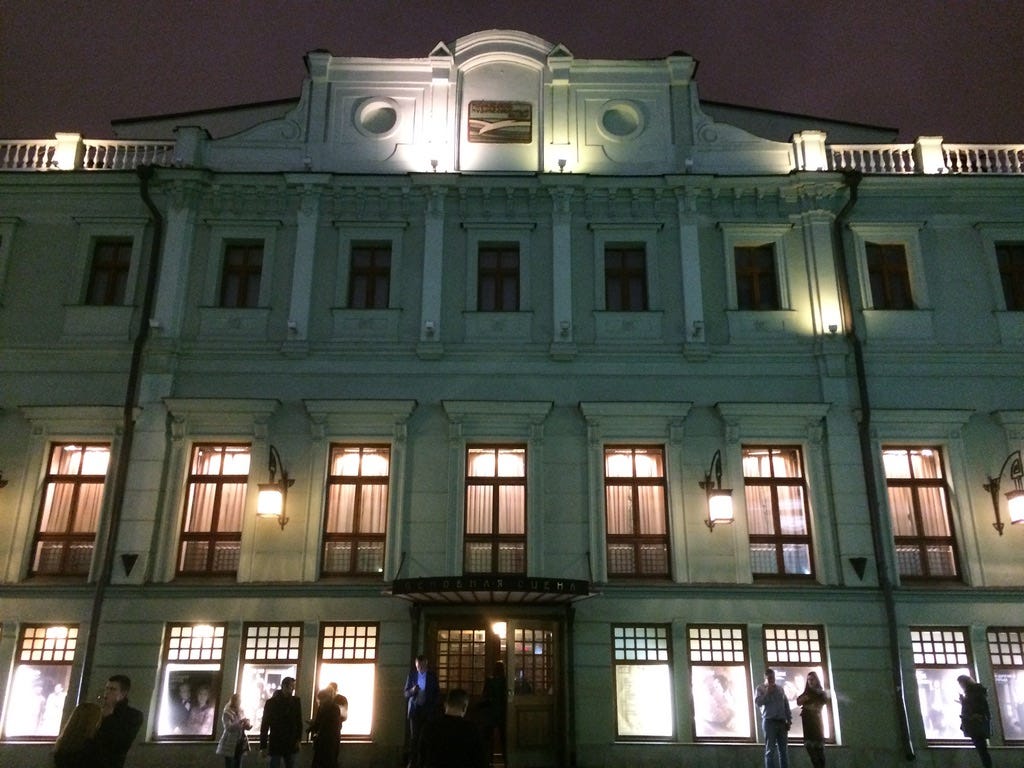
11 years ago this month, I studied abroad at the Moscow Art Theater School in Russia. In honor of this anniversary I’m publishing at least one essay a week about my time there.
The Russian set designer Boris Aronson, who did the sets for the original productions of Cabaret, Company and Follies (among others) had two rules of theater:
Rule One: In every theatrical production, there is a victim.
Rule Two: Don’t be the victim.
This axiom isn’t always true. I’ve done plenty of shows where there was no victim. But there are instances – usually when a show fails – where one person takes the blame, even though theater is a team effort. My semester studying at the Moscow Art Theater School began and ended with the worst shows I’ve ever worked on because it was the only time in my career that I was ever the victim. Fortunately, it did not overshadow the rest of my time there.
How did this come about?
First, some backstory: From 2014 to 2016, I attended graduate school at Harvard’s American Repertory Theater, which once offered a two-year training program for theatrical practitioners – specifically, actors, voice teachers and dramaturgs, a discipline that’s impossible to define and has probably made more than one HR person scratch their head when looking at my resume. Simply put, a dramaturg is the person in the room who, on a new play, mediates between the playwright and the director as an objective party to give notes; or, on a revival of an old play, helps the director construct their interpretation and does a shit ton of background research to help everybody out.
My motivation for getting this degree was less that I wanted to be a dramaturg and more that the program offered something no other graduate program in the United States did – a three-month study abroad at the Moscow Art Theater School (MXAT). Harvard didn’t have an undergraduate theater concentration until the year of my graduation, so A.R.T. had to partner with another school for the MFA. They chose MXAT to give out the MFA while Harvard would give us certificate. (It was only later that we all learned Russia doesn’t actually offer MFAs, which is one of many reasons the Department of Education shut the program down.)
Obviously I didn’t know any of this at the time. I just wanted to go to Russia and get the Harvard name on my resume because I thought it would mean instant employment after graduation (ha ha ha.) Besides, I am a huge nerd for all things Russia: As an undergraduate at Northwestern, I studied under one of the great Russian literature experts in the United States, Gary Saul Morson, who taught classes on Dostoevsky and Tolstoy. I had also memorized the major plays of Chekhov and acted in two of them—as Solyony in a high school production of Three Sisters (opposite Oppenheimer’s Alden Ehrenreich as Andre!) and as an A.D. and background pianist for a college production of The Cherry Orchard (opposite no one famous – yet.) Harvard’s program felt practically designed for me.
Throughout grad school, the dramaturgs would be assigned to work on plays that were either done on the mainstage of the A.R.T., or just faculty-directed productions starring the students. For my first year, I was assigned “The Russia Project” that the acting students would perform at MXAT. The previous year’s students had done a devised adaptation of The Brothers Karamazov; the students the year after us did Alexander Vvendensky’s play Christmas with the Ivanovs. Our project was an adaptation of the short stories of Nobel laureate Ivan Bunin that we called The Lonely Voice. The director was a MXAT faculty member named Ilya, who had sat in on our acting classes during our summer semester.
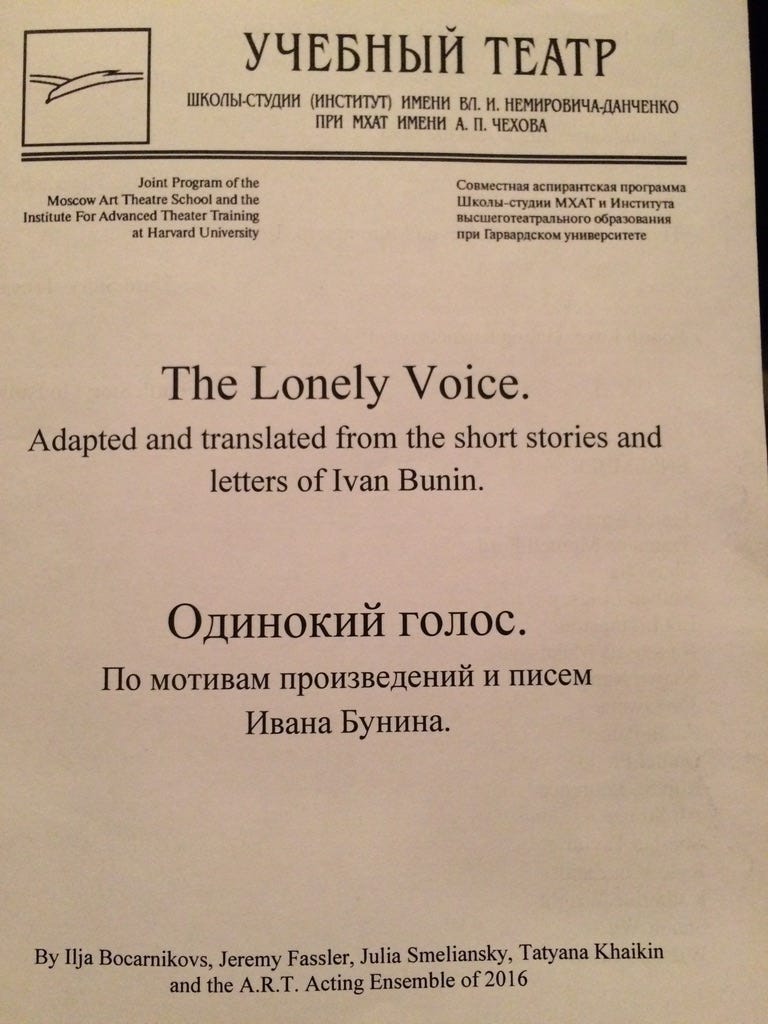
We began work on The Lonely Voice in January 2015, when we were all still in Cambridge. We built scenes from Bunin’s short stories while also telling Bunin’s life story, focusing primarily on the ups and downs of his relationships with women (there were A LOT.) I got along with Ilya, who also seemed to have a good rapport with both the company, I worked on the script while taking rehearsal notes. The one exception was our last rehearsal at the end of January, when I had to attend a conference at UMass Amherst. After that, Ilya flew back to Moscow, leaving us with a third of a script.
During the middle of our Cambridge rehearsals, Ilya made a startling decision to do a second play with us, Alexander Ostrovsky’s A Profitable Position. Ostrovsky was one of the most prolific Russian playwrights of the 19th century, and his plays are as familiar to Russian audiences as Tennessee Williams’ plays are to ours. However, he is significantly less well-known in the United States because his plays are untranslatable. The characters mostly speak in proverbs, and English flattens all beautiful Russian proverbs into banalities. Because of this, there was only one English-language translation of A Profitable Position. This made my job significantly easier, as I didn’t have to do line-by-line comparisons of 10 different translations to determine the best one, which I would have had to do if we were doing, say, Three Sisters. (Similarly, there were only two translations of Bunin’s stories, and I chose the newer one because many of the stories we did hadn’t been translated before.) I wrote a packet filled with background research on Ostrovsky and the context of the play, handed it and the script to Ilya, and never heard from him again regarding it.
I would not see Ilya again until I got to Russia, after a week of studying at the Krakow Theater Academy in Poland (a spectacular experience—Krakow is one of the best cities in the world.) We flew to Moscow on March 7, 2015, and our first full day was March 8, 2015.1 That morning, Ilya picked me up from the dorm and drove me to the theater. Having watched the pilot of Unbreakable Kimmy Schmidt the day before, my first week in Russia made me feel like Kimmy experiencing New York for the first time and being astonished by the speed of everything. If you think New Yorkers walk and talk fast, multiply that by three and you’ll understand how disorienting it is.
We sped down Tverskaya Street and pulled up to Kamergersky Pereoluk, the street where I would spend most of the next three months. Walking up to the MXAT for the first time, seeing the statues of founders Konstantin Stanislavsky and Vladimir Nemirovich-Danchenko, as well as the photograph on the side of the building of Chekhov and the original company members reading the script of The Seagull, I nearly burst into tears. This is where 20th century drama, modern acting, and the very concept of a repertory company all got started. I started crying. This is a common reaction – the French director Ariane Mnouchkine also broke down in tears the first time she came to the theater. If theater is the one place a secular person can have a religious experience, then MXAT is a temple.
It was the last time I’d feel that way the rest of the week, as I was thrust into that common American theater experience: Rewriting a show that’s in trouble. It gave new meaning to Larry Gelbart’s famous comment that “if Hitler is alive, I hope he’s out of town with a musical.”
For seven days, I was stuck in a black box trying to finish The Lonely Voice and fix what was wrong. The script we had come up with so far was unworkable. Lines that were given to certain actors in Cambridge were now spoken by other actors; much of the devising work that had been done was left out; and several passages were missing, including the ones from the one day of rehearsal I didn’t attend, even though the stage manager had given me what she had of them before I left. I later learned that the actors had little confidence in the play and were unwilling to rehearse in between Ilya leaving and their coming to Moscow because they assumed everything was going to change anyway—which in fairness, it did. I sat around rewriting everything in Final Draft, printing out pages for the actors, and trying not to get jealous of my dramaturgy classmates, who were already seeing plays at MXAT, many of which I wouldn’t get to see, as they didn’t appear in the repertory again. The only good thing about that week was that I read Crime and Punishment, the first of three Dostoevsky novels I’d read while in Russia.
The first performance of The Lonely Voice took place Sunday, March 15th, and while I can technically say I wrote a play that was performed at the Moscow Art Theater, I take no pride in it. The Lonely Voice is a horrible play with unspeakable dialogue, tangents about Bunin’s love life that make him seem less like a genius and more like a second-rate lech, and some horrific scenes of violence towards women. One of the short stories we performed opens with a man raping a woman, followed by him gaslighting her into believing it was consensual. To our credit, we raised this issue with Ilya in the first rehearsals, but he was the boss, and his explanation sounded good enough, so we backed off. I hope that if he tried this today, we’d be a lot more forceful in our complaints.
After opening The Lonely Voice, Ilya went into rehearsals with the actors for A Profitable Position—and again, never asked me to attend rehearsals, thank God, because I wanted to start seeing theater ASAP. I wouldn’t check in with that play until the final week in Moscow, when I saw the last performance. It was of the worst things I’ve ever seen, and I know the actors will not take offense when I say that because they hated doing it. Ilya basically directed them to scream at each other the entire time and missed the point of the play entirely. On our last day of classes, Ilya apologized to the actors for doing the play – but he didn’t apologize to me.
During that last week, our teachers came to see the plays. They liked The Lonely Voice—liked it enough to consider reviving it in Cambridge the next year—but hated A Profitable Position, and took some of their anger out on me for not fixing the translation. They were also frustrated about the miscommunications that happened during The Lonely Voice, blaming me and asking me to come in for a separate meeting to explain what went wrong. The meeting took place that summer, when I took a day trip to Cambridge while performing in a production of Fiddler on the Roof out in Plymouth, Mass. My Mom said to think of the meeting as my witness testimony to salvage my future in the program, so as evidence, I brought a 200-page binder of every draft of The Lonely Voice to explain exactly what went wrong, and to emphasize my lack of involvement with the Ostrovsky. Afterwards, I realized that for whatever mistakes I made, the reason the meeting took place at all was because Ilya threw me under the bus for everything that went wrong. I was the victim. Fortunately, the meeting succeeded on two fronts—I exonerated myself, and the Institute severed their relationship with Ilya, ending the possibility of a Lonely Voice revival.
My whole experience working with Ilya gave me PTSD that lasted the rest of my second year. I had to throw out my copy of Bunin’s short stories because I couldn’t look at it without shuddering. Hell, there were times that I winced just looking at the word “onion” because it had five letters and Bunin had five letters. The truth, I later learned, is that A.R.T. was a magnet for mean directors who acted like know-it-alls and broke you down without ever building you up. In the constellation of these meanies, however, Ilya was a minor figure, somewhere above Karin Coonrod and beneath David Hammond (IYKYK). And I only had to deal with Ilya’s fuckery for one week, after which I could get on with my life in Moscow and do the things I really wanted to—see theater, learn as much as possible, and explore this extraordinary city.
One postscript to all this: The day I went to Cambridge with the script, I shared a car ride into town with none other than Bobby Morse, whose daughter Allyn co-starred in Fiddler. Morse had originated the role of J. Pierrepont Finch in the musical How to Succeed in Business Without Really Trying, which, four decades later, would land him the role of Bert Cooper on Mad Men. He asked what was in the binder, and I told him it was the script for The Lonely Voice. He looked at the 200+ pages in there and said, “you mean they had to memorize that?”
Fun fact: Russia doesn’t do Daylight Savings Time, so this was the only time in my life I didn’t lose an hour of sleep, which, after traveling from Poland to Russia all day, I really needed. Thanks, Russia!
I once spent a Thanksgiving evening in London with Tom Cruise when he was still married to Nicole. She was making Portrait of a Lady and onset that night. So we ate pasta, played with Connor who was still a toddler, and hung out with Tom's assistant, another Robert Morse daughter, Andrea. Everything connects.