
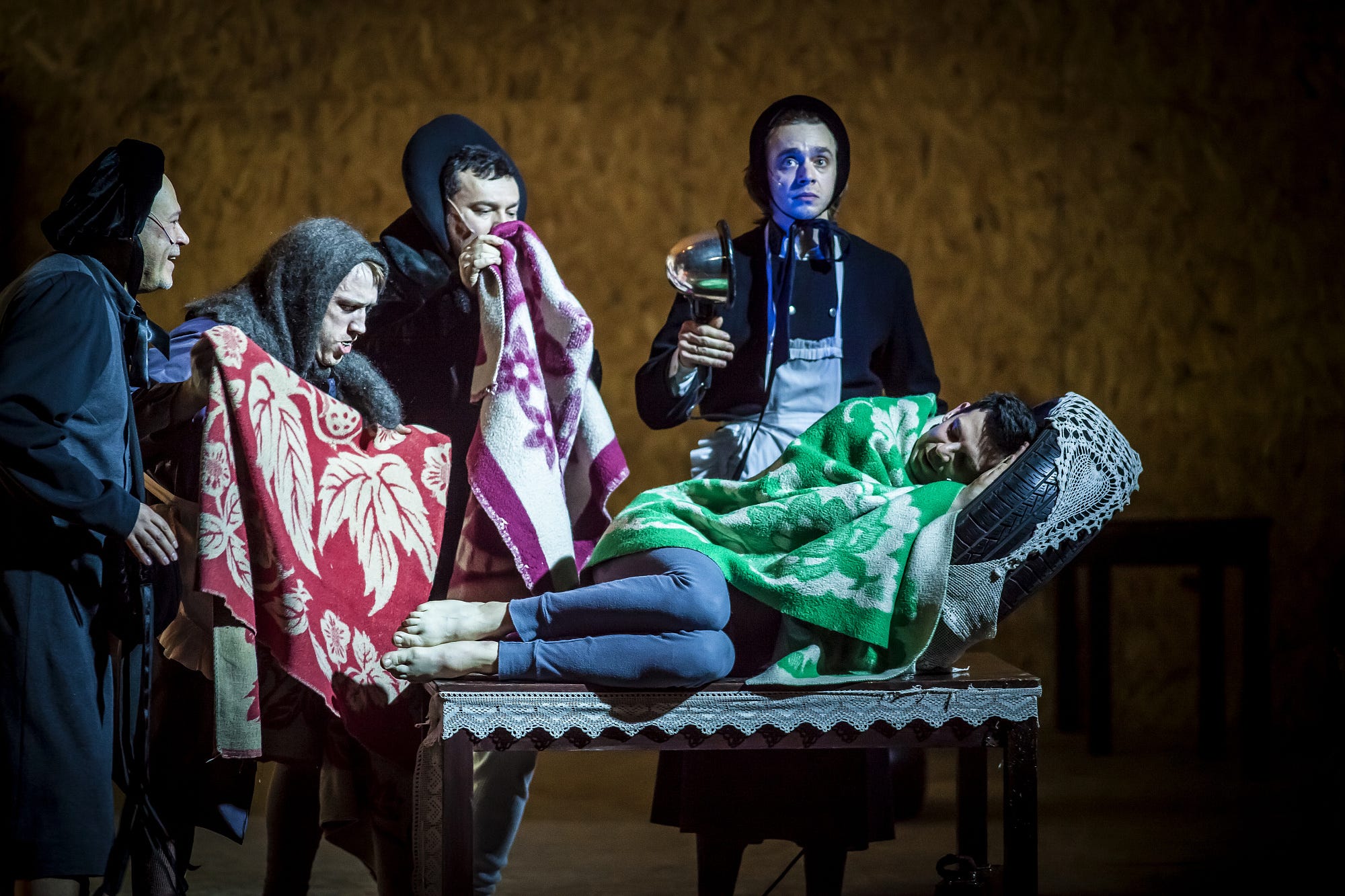
Before going to Harvard, I majored in Performance Studies at Northwestern. One of the oldest departments in the school, Performance Studies began as oral speech training1 and by mid-century had evolved into adapting literature for the stage. Since I loved reading and theater, I chose Performance Studies instead of a theater major because it was more academically rigorous, and because I love adapting literature. I’ll confess it was not without its social downsides: I never got to take an acting class with the theater majors and wasn’t invited to any of their acting class parties. On the other hand, I got to take classes I would never have taken anywhere else, like “Performing Film Noir” and “Performing the American 1950s.”2 It also gave me the creative freedom to flex my muscles as a writer and director, which climaxed my junior year when I adapted John O’Hara’s Appointment in Samarra for the stage.
It should come as no surprise that the Russians love adapting literature for the stage. They have a rich history of literature to draw on, and the psychological realism of characters like Raskolnikov and Anna Karenina make them actors’ dream roles. Some of the greatest productions in modern Russian theater are adaptations of novels, most notably director Lev Dodin’s nine-hour play of Dostoevsky’s Demons, which is high on my list of Shows I Wish I’d Seen. Here are a few stage plays of novels that I did see from my first month of theatergoing:
The Sound and the Fury – A group of MXAT acting students devised and performed this adaptation of William Faulkner’s breakout novel, which changed my life when I read it in high school. The most memorable performance came from the actor who played Benjy Compson, the “idiot” son whose memories comprise the first fourth of the novel. His physical contortions as his siblings undressed him, limbs writhing out of control at the most basic of actions, allowed us to empathize with him without feeling like the actor (or Faulkner for that matter) condescended to him. Unfortunately, he promised he’d take us out drinking afterwards but he totally flaked on us. Not that I’m upset or anything.
The Master and Margarita – One of the 10 greatest novels of the 20th century, Mikhail Bulgakov’s The Master and Margarita has become a staple of Russian theater, with most major companies having their own adaptation in the repertory. This production, directed by János Szász for MXAT, was only five years old at the time but already showed its age: the stage violence felt hokey, and although some of the digital backgrounds looked cool, the flying sequence where Margarita flew over aerial images of Moscow, felt like a bad imitation of Disney’s Soarin’ Over California. The adaptation also made the mistake of focusing primarily on the love story between the title characters and knocking the devil Woland and his associates to the side. This flattened the novel’s satiric edge and robbed the audience of the comic relief provided by Woland’s henchman Behemoth, the six-foot-tall Black cat whose constant swearing and drinking make him one of the funniest characters in all of literature (and played by Anora’s Yura Borisov in a recent film of the book).3 Still, I’m grateful to have seen it because it was the one play I saw to feature Igor Zolotovitsky, a wonderful actor who was my classmates’ acting teacher in Cambridge and Moscow, and who passed away last January at 63.
Sir Vantes: Donkey Hote – My first exposure to the theater of Dmitry Krymov, whom I profiled for The New York Times a few years ago. This wordless, 90-minute play based on Don Quixote starred two people standing on top of each other in a long coat – a.k.a. Vincent Adultman from BoJack Horseman – as Cervantes’ country gentleman who goes insane from reading too many second-rate Medieval romances and thinks himself a knight. In a scene echoing the chapter where men come and steal his books to try and “cure” him, Donkey Hote (the misspelling is intentional) undergoes an autopsy behind a white muslin, during which the actors pull silhouettes out of his head shaped like images from the novel, such as him attacking the windmill. Donkey Hote-Adultman reappeared in Krymov’s adaptation of Our Town, Everyone’s Here, filmed for Stage Russia and streaming on Kanopy.
The Karamazovs – I mentioned in my essay on An Ideal Husband that Konstantin Bogomolov’s five-hour adaptation of Dostoevsky’s magnum opus was one of the few plays I saw that broke me – as one of my teachers said, “it’s also too long for Russians!” It still had its moments: for his performance as evil patriarch and murder victim Fyodor Pavlovich Karamazov, actor Igor Mirkurbanov used the exact same high-pitched squeal that my professor at Northwestern, Gary Saul Morson, used for Fyodor’s voice. It also featured Alexei Kravchenko as a perfectly cast Ivan Karamazov, and he delivered his monologue about atheism very well. But overall, the show was plodding, with none of the dark humor present throughout Dostoevsky’s works. It’s one of the few shows I’ve ever walked out of.
Dead Souls – Widely regarded as the funniest novel in the Russian language, Nikolai Gogol’s Dead Souls is about Pavel Ivanovich Chichikov, a former government official and con artist who buys dead serfs off of their owners, who keep their names in the register even after they died, a common practice among serf-holders. Along the way, Chichikov meets townspeople who range from depressed widows to braggart hunters, all the while getting the better of them. Although the book is episodic and has no linear plot, its many comedic setpieces make it ideal for stage adaptation.
Kirill Sebrennikov, Dead Souls’ director, was then one of the rising stars of Russian theater and an innovator in theater space. At the time, he was the artistic director of the Gogol Center. Before he took it over in 2013, the Gogol Center had a reputation as the worst theater in Moscow. By the time I was there it was one of the best, not just because of his artistic programming but because he’d transformed the space into something akin to off-Broadway theaters like Signature and the New Studio on 42nd, with a café out front and an auditorium that could be reconfigured from proscenium to arena setting. I always took advantage of the café whenever I went, both to get work done and to mingle with other theatergoers.
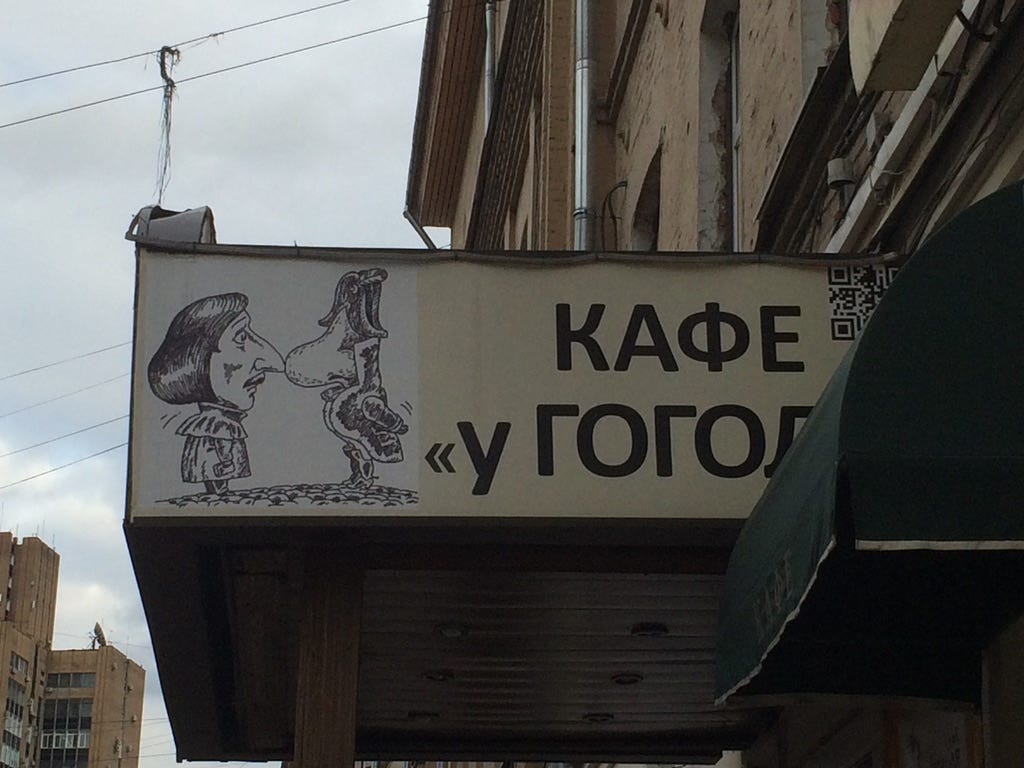
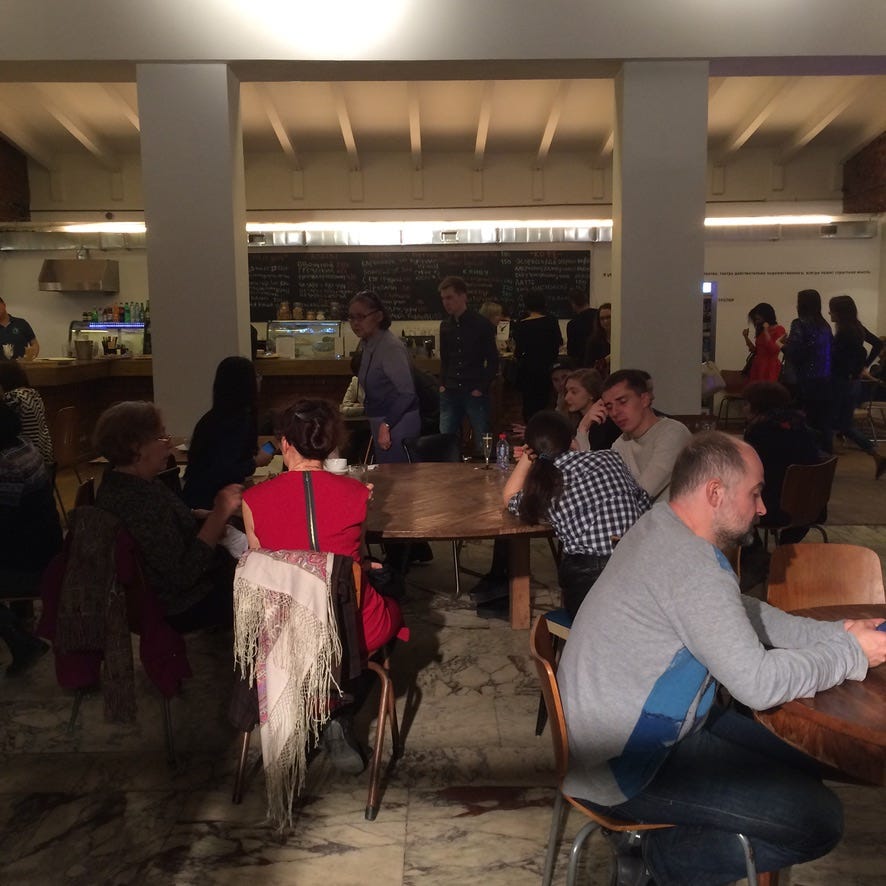
Serebrennikov’s Dead Souls began with the wheels coming off Chichikov’s wagon on the road, a metaphor symbolizing how you can’t drive through a country that has never fully organized its roads – how can you drive across a tundra? Gogol’s protagonists, like Chichikov, struggle through chaos without attempting to impose their own rules on it, rather just chipping away at the existing order one bit at a time, like buying dead serfs. The antagonists in his works are often those who desire to impose their systems on others, such as in his play Marriage, about a man whose best friend forces him to get married, which director Anatoly Efros depicted as a metaphor for communism in his famous 1970s production. Serebrennikov played with aspects from Marriage, as Chichikov weasels his way out of a forced marriage before getting sent to prison. The production as a whole was hysterical and introduced me to one of my favorite actors in Moscow, Yevgeny Sangadzhiyev, who donned drag to play the wife of one of Chichikov’s victims. It was also the only show I saw in my whole study abroad to have English subtitles.
Alas, the excitement that the Gogol Center brought to Russian theater is no more: it closed following the invasion of Ukraine, and Serebrennikov, who’d provoked authorities for years and even undergone house arrest for his outspoken political views and his open homosexuality, fled the country. Their loss.
Fun fact: Lionel Logue, whom Geoffrey Rush played in The King’s Speech, studied oratory at Northwestern in the 1910s.
Fun fact 2: The very first day of Performing the American 1950s, my teacher, Paul Edwards, teacher showed us Barbie commercials and lectured us about the atom bomb. This means Paul Edwards invented Barbenheimer. Thank you for the memes, Paul!
This Master and Margarita film, produced in Russia, came out to excellent reviews in 2024 but is caught up in litigation and has yet to secure a US release. An English-language film of the book has yet to be made, although Baz Luhrmann took a shot at it before walking away from the project two years ago. My personal choice to direct it would be Guillermo del Toro. Guillermo, if you ever find yourself reading this, call me.