
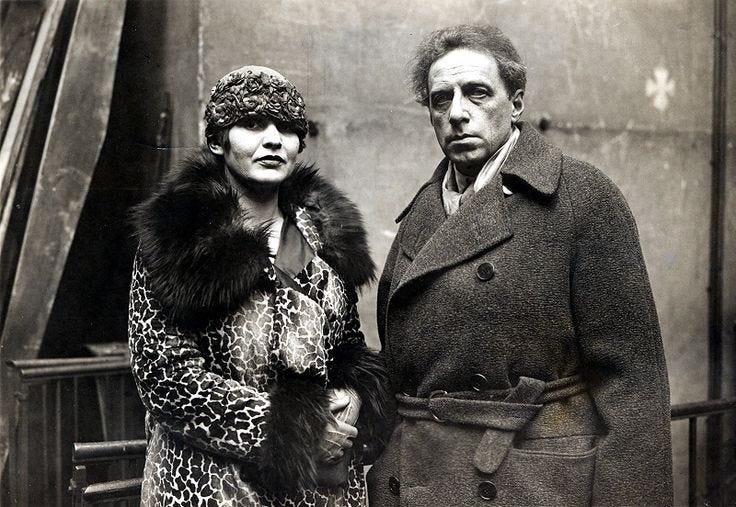
During my time in Moscow, I took a class in an apartment where a woman had her eyes gouged out by Stalin’s secret police.
The apartment belonged to Vsevolod Meyerhold, who was, along with Konstantin Stanislavsky, one of the two most influential Russian stage directors of the 20th century. His apartment is now a museum dedicated to his life and work. Nina Nikolaevna, who ran the museum and taught our class, was a Meyerhold obsessive who possessed the uncanny superpower of tying anything that you brought up to Meyerhold. And I mean anything—I swear to God, if I’d asked her to tie The Room to Meyerhold, she could have done it.1
It was the least interesting course I took in Moscow, since I had already taken several classes on Meyerhold in Cambridge and in undergrad at Northwestern, and Nikolaevna didn’t add anything new to my understanding of his work. But my inability to concentrate on her lectures had as much to do with the location as anything else.
In June of 1939, Meyerhold was arrested in Leningrad for a speech he gave at the All-Union Conference of Theatre Directors, in which he decried the barren Moscow theater scene that Stalin had decimated. According to Meyerhold biographer Yuri Yelagin, he said:
“Without art, there is no theater! Go visit the theaters of Moscow. Look at their drab and boring presentations that resemble each other and are each worse than the others. . . . Everything is gloomily well-regulated, averagely arithmetical, stupefying and murderous in its lack of talent. Is that your aim? If it is-oh! you have done something monstrous! You have thrown out the baby along with bathwater. In hunting down formalism, you have eliminated art.” [italics mine]
A month after his arrest, the NKVD broke into his apartment and stabbed his wife, actress Zinada Reich, 17 times, gouging out her eyes in the process. Her blood was still on the wall when the caretaker found her body. The apartment was passed on to NKVD chief Lavrenty Beria, a child rapist and torturer played chillingly by Simon Russell Beale in Armando Iannuci’s The Death of Stalin. To this day, we do not know the identities of her assailants or the motivation for her murder.
My home in LA is up the street from where OJ killed Ron and Nicole2, and I feel more comfortable walking by it than I ever felt in Meyerhold’s apartment.
Dictatorships persecute artists because they speak truth to power, but not only for that. Art is abhorrent to the totalitarian because it provides people with an alternative to the governing “ism.” My teacher, Moscow Art Theater (MXAT) dramaturg Anatoly Smeliansky, once asked Mikhail Gorbachev how the Soviet Union ended without a war. Gorbachev said, “Soviet life had a lot of problems, but it built libraries all over the country, so matter where you were, you could find Chekhov and Tolstoy. If you read those authors, you know what life is about and you will be done with Communism.”
Artistic innovation in Russian theater stagnated in the 1930s because Stalin mandated that all theater conform to Socialist Realism, which demanded that plays conform to Soviet ideology, and be representational and relatable to the masses—so basically, propaganda. Due to MXAT’s status, Stalin and his culture ministers made it and Stanislavsky the standard for all theater to aspire to: it had already premiered the most famous plays in the country’s recent history—most of which had been realistic—and developed a system for training actors that could be copied elsewhere. In making Socialist Realism the only acceptable theatrical “ism,” anyone who dared express an alternative point of view automatically became an enemy.
Meyerhold, who embraced every ism that permeated Russia at the turn of the 20th century, might have been safe if he had stuck to realism, but his restless personality would never have allowed that. As an original ensemble member of MXAT, he played Konstantin in Stanislavsky’s 1898 production of Anton Chekhov’s The Seagull, which cemented the theater’s reputation and established the play as a modern classic after its disastrous 1896 premiere in St. Petersburg. In 1901, he originated the role of Baron Tusenbach in Three Sisters, a role Chekhov wrote for him. Stanislavsky viewed him as a prodigal son, but Meyerhold broke with him due to his burgeoning social conscience (Stanislavsky was largely apolitical), as well as a dispute over the company’s financial restructuring.
Meyerhold then moved to Kherson, in Ukraine, where he staged and/or acted in more than 150 plays in two years—in his first season alone, he did 79 plays. One of them was Chekhov’s final play, The Cherry Orchard, in which he played the upstart tutor Trofimov, a role he probably would have originated if he’d stayed at MXAT. Both Chekhov and Meyerhold did not like Stanislavsky’s production of the play, because he made the same mistake I’ve seen many directors make: they interpret it as pure tragedy and ignore how it’s really Chekhov’s Arrested Development.3 This excerpt from a letter Meyerhold wrote to Chekhov about the production offers a glimpse into how he had begun to expand his artistry:
“Your play is abstract… Above all else, the director must get the sound of it. In Act Three, against the background of the mindless stamping of feet—it is this ‘stamping’ that must be heard – enters Horror, completely unnoticed by the guests: ‘The cherry orchard is sold.’ They dance on. ‘Sold’—still they dance. When one reads the play, the effect of the third act is the same as the ringing in the ears of the sick man in your story ‘Typhus.’ A sort of itching. Jollity with overtones of death. In this act there is something Maeterlinckian, something terrifying.”
“Maeterlinckian” refers to Belgian playwright and theorist Maurice Maeterlinck, whose essays on symbolism influenced Meyerhold and other Russian writers who embraced it as an alternative to realism. In plays like The Blue Bird, Maeterlinck emphasized fairytale-like settings with characters who were more allegorical than realistic, a fascination with death and fate, and a desire to make theatergoing an act of secular religiosity itself, all of which Meyerhold would strive for. He returned to MXAT in 1905 to establish a studio adjacent to the main company that would rehearse and produce Symbolist plays. The studio did not succeed, as its first production was cancelled following a disastrous dress rehearsal, but his interest in Symbolism rubbed off on Stanislavsky: his 1908 Symbolist production of The Blue Bird was one of his biggest hits; and he collaborated with British designer Edward Gordon Craig on an influential 1912 Hamlet.
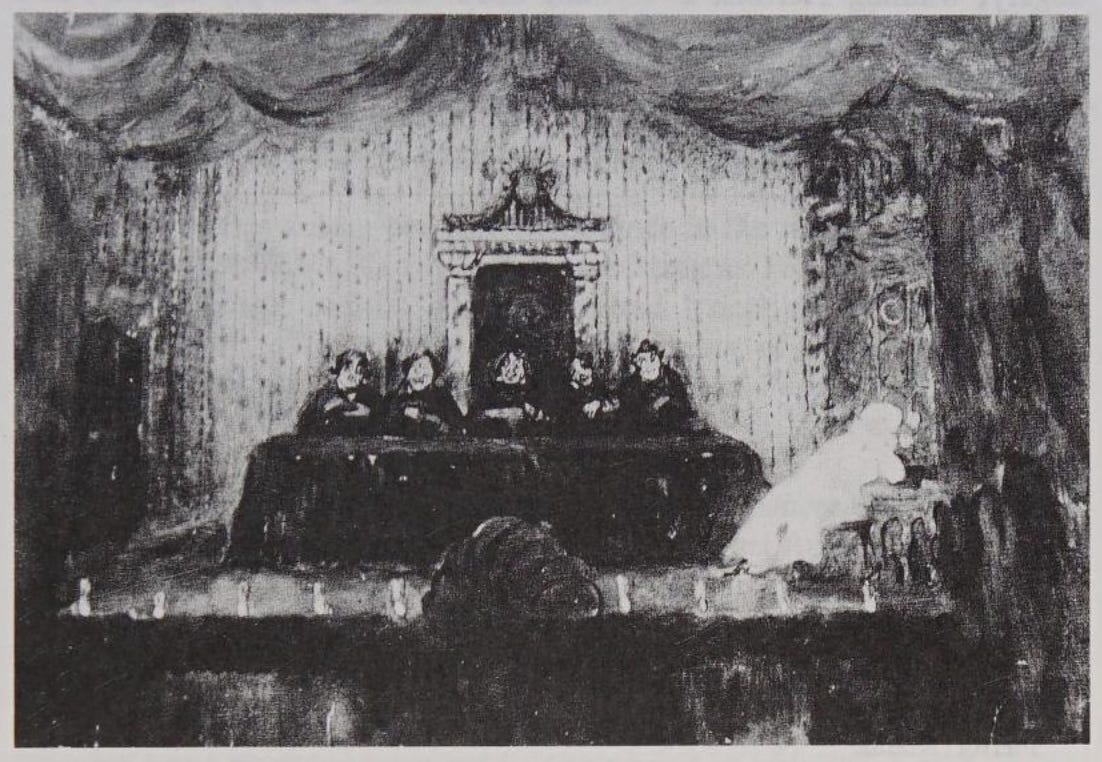
A year after the studio’s closure, Meyerhold staged Alexander Blok’s The Fairground Booth in St. Petersburg, a play about the French clown Pierrot (whom Meyerhold played in one of his greatest performances) and his pursuit of the beautiful Columbina. This Symbolist production demonstrated how clashing styles like circus and commedia, and the use of character archetypes like Pierrot and Columbina, created a formal tension that could replace Aristotelian principles of dramatic tension. Meyerhold called this “grotesque”:
“It is the style that reveals the most wonderful horizons to the creative artist…. The grotesque does not recognize the purely debased or the purely exalted. The grotesque mixes opposites, consciously creating harsh incongruity…. The basis of the grotesque is the artist’s constant desire to switch the spectator from the plane he has just reached to another that is totally unforeseen.”
Up to 1917, Meyerhold continued to work through Symbolism and the grotesque, developing new techniques with his actors that moved beyond Stanislavsky’s realism so that they spent less time trying to perfectly imitate what an old person would sound like and more about the impact that voice would have on the audience. He encouraged them to improvise based off of comedic lazzi – prompts from commedia plays that could be as simple as “tie your shoelaces” – and the actors would devise scenes based off of them called études.
Following the Revolution, Meyerhold joined the Bolsheviks and briefly ran the Soviet theater department. In a manifesto repudiating Stanislavsky and what would come to be called “the Method,” he wrote, “the psychological makeup of the actor will need to undergo a number of changes. There must be no pauses, no psychology, no ‘authentic emotions’ either on the stage or whilst building a role.”
The throw-stuff-at-the-wall ethos of the early Soviet Union suited Meyerhold. His devotion to refining actors’ physicality led to the creation of biomechanics, a series of physical exercises along the lines of the grotesque meant to eliminate superfluous movement that grew out of études, as poses are accompanied by prompts like “man draws cross-string bow,” accompanied by instructions for the actor to properly contort himself. He would put this on display in his 1921 production of The Magnanimous Cuckold.
Written by Fernand Crommelynk, The Magnanimous Cuckold is the most famous play theater students haven’t read, because nobody ever teaches the text—it’s basically a trashy play about a guy whose wife sleeps around a lot—they just teach Meyerhold’s production. All you need to get a student’s attention is a picture of Liuba Popova’s set:
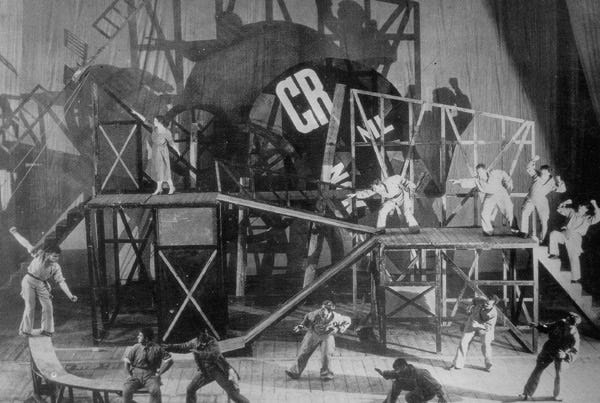
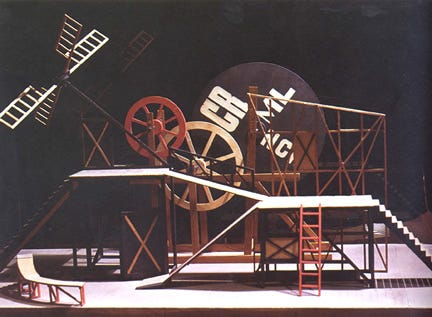
Every time I look at it, whether in photographs, scale models, or this video of a re-creation of the play by students at the University of Iowa, the only word that comes to mind is “badass.” You could do any play on it—even the horribly reviewed Broadway production of Dog Day Afternoon that opened this week—and I would still want to see it. Popova designed this constructivist jungle gym with biomechanics in mind, as its malleability allowed the actors to break down their movements one step at a time. The play itself was secondary to the fact that Meyerhold now had a technique, and actors, who could physically free themselves from what he called “emotional narcotics.”
The other 20s production Meyerhold devotees obsess over is his revival of Nikolai Gogol’s The Government Inspector, which became the foundation for all productions of the play ever since. A farce about a con man who tricks the residents of a small town into thinking he’s a government inspector, Gogol’s play is to Russian theater what Our Town is to American theater: everyone has read it in school, or seen it, or been in it, and it seems so self-explanatory that you ignore its deeper meanings. For nearly 100 years, audiences had been subjected to hacky productions of it that begged for laughs. Much the way he sensed the “jollity with overtones of death” in The Cherry Orchard, Meyerhold knew that a successful production of The Government Inspector must emphasize both the comedy and the drama pulsating underneath.
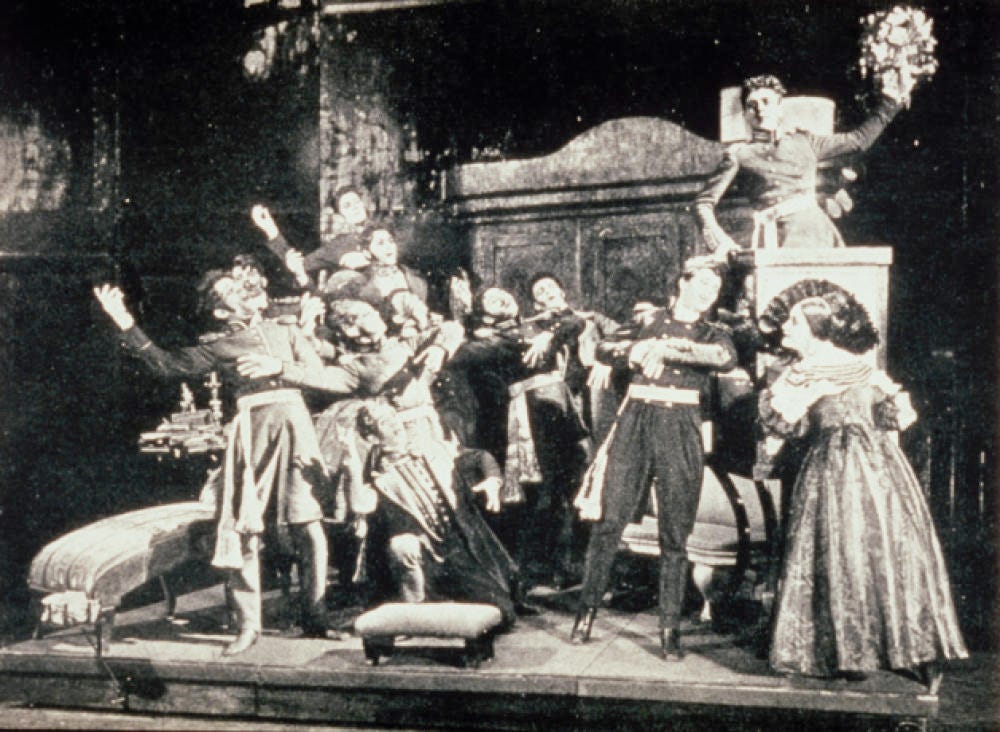
Meyerhold’s process for The Government Inspector owed much to Stanislavsky in that he gave the actors detailed biographical notes for their characters emphasizing their given circumstances, but broke away from his realism with striking visuals and costume designs (Khlestakov, the con man, was visualized with geometric right angles and very deliberate biomechanical movements), and he encouraged the actors to find their own eccentricities. He staged some scenes simultaneously, such as having every bribe the townspeople offer Khlestakov take place at once. Most impactfully, at the end of the play, after the characters have discovered Khlestakov isn’t the real government inspector, but the actual government inspector is about to arrive, the show curtain moved from the bottom to the top of the stage with the telegram announcing the arrival printed on it – and when it disappeared into the rafters, all the actors had been replaced with mannequins of themselves, their faces frozen in terror.
Although Meyerhold never stopped directing, the totalitarianism of the Soviet state caused frequent setbacks. In 1928, he was set to direct the premiere of Nikolai Erdman’s satire of Soviet life, The Suicide, but Stalin shut it down before it could open. (The play was not staged in the Soviet Union until the 1980s, a decade after Erdman died.) His 1937 production of the play One Life was cancelled by the Glaverpertkom, the censorship board. The government shut down his theater for good in 1938, and the one he built to replace it was never finished. At this point, only Stanislavsky had the power to protect him. Both men had a healthy respect for each other, and Stanislavsky offered him a job as his assistant at his new musical theater. Unfortunately, Stanislavsky died in 1938, before Meyerhold could take the job.
In June of 1939, Meyerhold attended the directors’ conference and gave the speech that supposedly led to his arrest. I say “supposedly” because it wasn’t until late in the writing of this essay that I learned he didn’t give the speech Yelagin quoted him as giving. The full content of the speech would not be published until 1991, but Alexander Kaun’s 1978 book Soviet Poets and Poetry contains excerpts that would appear in that version:
“We must bring to light the fundamental mistakes of the formalists and naturalists, so that these mistakes may not be repeated. We who had erred, who had caused considerable damage to art—myself, [Dmitri] Shostakovich, and Sergei Eisenstein—have been given full opportunities to work, and to rectify our mistakes… Who knows what outrages the formalists might have committed in art had they not been stopped in time. For this reason the closing of the theater which I had directed was perfectly just. This is a lesson for all those who follow wrong paths in art.”
Meyerhold even went so far as to apologize for the liberties he took in his interpretation of The Government Inspector, a mistake he described as “the substitution of external form for inner content,” and praised Stalin as “our leader, our teacher, the friend of toilers throughout the world.” Attendees were stunned that one of the giants of Soviet theater had capitulated to Stalin. Critic Moissei Yankovsky said he had “destroyed everything that he has stood for throughout his life.” Meyerhold’s state of mind is impossible to ascertain—the most logical explanation one can surmise is that perhaps he thought it would allow him to keep working.
So why was he arrested? The truth, as outlined by biographer Edward Braun, is that NKVD arrestees had already named Meyerhold as a foreign agent for the Japanese two months before the conference. Stalin—who never attended Meyerhold’s theater—summoned writer Alexander Fadeyev, who had spoken in support of Meyerhold, to a meeting in May 1939, telling him “with your permission, we intend to arrest Meyerhold.” If Fadeyev did not tell Stalin directly to arrest him, he did not try to stop it, either.
Reading Meyerhold’s descriptions of his life in prison reveal the brutality of the NKVD. In a letter to Chairman Vyacheslav Molotov, he wrote:
“They beat me, a sick sixty-six-year-old man. They laid me face-down on the floor and beat the soles of my feet and my back with a rubber truncheon…. In the days that followed, when my legs were bleeding from internal hemorrhaging, they used the rubber truncheon to beat me on the red, blue and yellow bruises…. I screamed and wept with pain…. Lying face-down on the floor, I discovered the capacity to cringe, writhe and howl like a dog being whipped by his master.”
In the subsequent months, he was repeatedly tortured, forced to sign false confessions, named names, and put through a show trial. In February 1940, he was executed and buried in a mass grave. Perhaps most chillingly of all, we have no evidence that he ever learned what happened to his wife.
Meyerhold was subsequently erased from Soviet life, removed from photographs like other Stalin enemies. He was rehabilitated in the 1950s during the first wave of de-Stalinization, and his influence can be felt today in everything from the plays of the late Russian director Yuri Butusov, which broke down The Seagull and King Lear into études, to the constructivist towers of Boris Aronson’s set for the original production of Company, and the traveling skywalks of the Paris Opera House in The Phantom of the Opera - Company and Phantom director Hal Prince was a huge Meyerhold fan. But I didn’t spend all week writing this so that you could go “well, I’m sorry he died, but, if it weren’t for him we wouldn’t have Phantom!” because that’s not the world we live in.
The loss of Meyerhold wasn’t just the loss of a great director: it was the loss of his techniques. 11 years ago this week, my classmates gave their Meyerhold presentation, in which they presented us with biomechanics prompts like drawing the cross-string bow to try them ourselves — mostly without success. While many of Meyerhold’s notes survive, the notes on biomechanics were lost, and many of the people who learned it from him were suppressed or killed. Those who survived spread his teachings from person to person like a game of telephone, the meaning blurred by those who added to it. All attempts to revive them as originally done, even in the Iowa production of The Magnanimous Cuckold, are best guesses.
My classmates did a fine job with the presentation, but what I remember best is the anger in Anatoly Smeliansky’s voice during his wrap-up lecture. The right-wing backlash over the productions of Tannheuser and An Ideal Husband, which climaxed that week with the pig incident, showed how the religious right didn’t just attack plays that challenged their worldviews; they attacked art itself. If they’d been around in the 30s, they would have advocated for Socialist Realism too, because Socialist Realism was less of an artistic school of thought that purported to promote the teachings of Stanislavsky, and more a means to suppress all dissenting voices.
“Socialist realism is one of the best ways to kill people,” Anatoly said. “This ‘realism’ is the enemy of art, and the enemy of ‘realism.’ It is just a propaganda idea. It’s dangerous to give power to someone who has his own vision of theatre. He wants to create everything as a model of his own life.”
I’ll keep that in mind the next time I drive by the Kennedy Center.
I could probably do it too, but this essay already took me long enough to write.
I’d kick myself if I didn’t add one of my absolute favorite stories: When Bill Clinton visited Russian President Boris Yeltsin in 1995, Yeltsin’s first question to him was “do you think OJ did it?”
“Now the story of a wealthy family who lost everything, and the one former serf who had no choice but to keep them all together.”