The Moscow Diaries: "Who Censored Laura Palmer?"
Or: How the Russia's religious right protested a play which climaxed with a Twin Peaks homage

I don’t speak fluent Russian, but I know that “kto ubil Loru Palmer?” means “who killed Laura Palmer?”
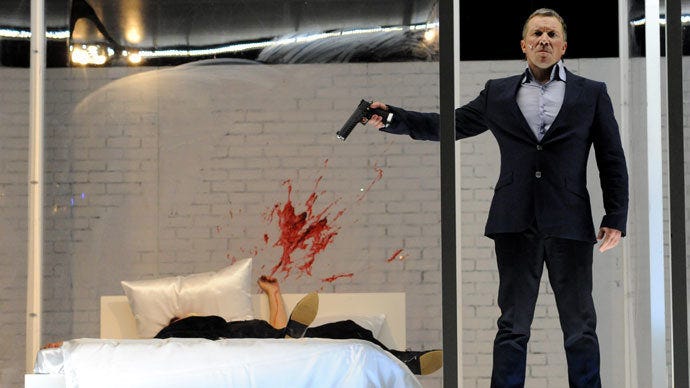
In Act Three of the Moscow Art Theater’s production of Oscar Wilde’s An Ideal Husband, directed by Konstantin Bogomolov, a character repeatedly asks David Lynch who killed Laura Palmer while Lynch cries and eats Twinkies. If cinephiles weren’t already interested, the actor playing Lynch was Alexei Kravchenko, who not only looks exactly like Lynch but also played the little boy in Elem Klimov’s Come and See.1 It was one of the funniest things I’ve ever seen on stage, even as I asked myself a question I’d ask many times while seeing theater in Moscow – “what the fuck is going on?”
You don’t have to have read An Ideal Husband to know that it doesn’t have Twin Peaks, the three sisters, rock music or Dorian Gray. Listing all these together makes it sound like I’m Bill Hader as Stefon describing New York’s hottest club on SNL, and this goes for many of the other plays I saw in Russia. It was also four and a half hours long.
The actual play An Ideal Husband is about Robert Chiltern, a member of the House of Commons who is blackmailed by his wife’s rival, Mrs. Cheveley, to invest in building a canal or she’ll reveal that he built his fortune on insider trading. This grounds the ensuing comedic misunderstandings with real-world stakes, which take on even greater significance given that the same year as An Ideal Husband premiered, Wilde was arrested and tried for gross indecency.
MXAT had previously staged Wilde’s play in 1946, where it had also caused controversy. According to The New York Times, critic P. Novitsky attacked the theater for performing Wilde, asking, “what creative purpose is solved by the play?” He praised the theater’s recent production of Richard Brinsley Sheridan’s School for Scandal, which “seethed with scathing and satirical, though noble, moral indignation,” but called An Ideal Husband “cold, dignified and indifferent to the fate of human beings.” This is nothing compared to the scandal of Bogomolov’s production, which took only the blackmail from the text and the homosexuality from the subtext.
The plot Bogomolov devised dealt with an assassin-turned-rock star, Lord, played by Bogomolov favorite Igor Mirkurbanov, who spends the first of the play’s three acts singing bad rock songs and dealing with a love triangle between himself, male government minister Robert Ternov (also played by Kravchenko) and Lord’s ex-girlfriend. Ternov is blackmailed into marrying Miss Cheveley, and they commit mutual suicide at the play’s end.
Lord and Ternov, critics pointed out, are allegories to Vladimir Putin and Dmitry Medvedev, who switched roles as President and Prime Minister from 2008 through 2012, when Putin returned to the presidency. In Act Two, they take a backseat to Dorian Gray, who resembles Putin not just for his bullying but because his vanity recalls Putin’s shirtless photos and hyper-masculine fixation. That act, which ends with a naked woman suspended in midair on a crucifix, was the catalyst for one of the most notable controversies in modern Russian theater, one which would climax with a dead animal on the steps of MXAT.

The return of the Russian Orthodox Church following the collapse of the Soviet Union brought back a far-right religious zeal not unlike the kind seen in the American Evangelical movement. The main difference between us and them is that without the precedent of a First Amendment, it is easier for the Orthodox Church to have their way when it comes to prosecuting anyone who dares offend them.
In February 2012, five members of the punk rock collective Pussy Riot performed an anti-Putin anthem called “Punk Prayer: Mother of God Drive Putin Away” in Moscow’s Cathedral of Christ the Savior. A month later, three members of the group, Nadezhda Tolkonnikova, Maria Alyokhina and Yekaterina Sumtsevich, were arrested that March and sentenced to two years’ imprisonment after a trial that resembled a kangaroo court. Sumtsevich was freed in October of that year; Tolkonnikova and Alyokhina in 2013. The justified international outrage over this decision led Russia to do what it does best – double down. In April 2013, the Duma (Russia’s parliament) passed an anti-blasphemy law targeting anyone who “intentionally or…publicly offend[s] religious sensibilities” and/or “desecrate[s] religious sites and paraphernalia,” carrying prison sentences of up to three years.
An Ideal Husband, which premiered the same year as the passage of this law, became a cause célèbre when Orthodox activists from the group God’s Will (think the Westboro Baptist Church) leapt onto the stage to denounce the production during the cross scene. One of the two activists, Dmitry Enteo, said they did it to “appeal to the hall’s conscience. We explained that an infernal blasphemy was happening on stage: a naked woman was hung from the ceiling and representing the crucified Jesus Christ, and an actor playing a homosexual priest was worshipping her. This deeply offended us.” Later, he posted on Twitter that he would “strive to have Bogomolov receive three years in jail for offending the feelings of believers.”2
God’s Will continued its campaign against An Ideal Husband by gathering signatures to force the Committee of Inquiries to Moscow to investigate both it and another MXAT Bogomolov production of Dostoevsky’s The Brothers Karamazov. Said Archpriest Vsevolod Chaplin: “Today, believers not only can, but must ensure that law enforcement agencies examine and give a clear estimation as to whether this is a violation of the law that has, for many years already, banned desecration of objects venerated by the faithful… The people who committed this unlawful act must answer for it.” This led to a court case with the epic title “Moscow Art Theater vs. God’s Will,” which was thrown out. But censorship, which had not been so prevalent since the days of the Soviet Union, had darkened the theatrical landscape.
Shortly before my arrival, the Russian Orthodox Church found a new target for their anger: A production of Richard Wagner’s Tannheuser at the Novosibirsk State Opera and Ballet Theater that premiered in December 2014. Timofey Kulyabin, who staged the production, had featured scenes that religious critics claimed took the Bible in vain, including one where a woman holds a cross with Jesus between her legs. Several artistic luminaries, including MXAT Artistic Director Oleg Tabakov, defended Kulyabin’s freedom of expression. A trial against Tannheuser opened on March 5, 2015 and was thrown out of court five days later, in no small part due to the testimony from religious scholar Boris Falikov, who called it “religious ignorance” for “a believer to equate an artistic construct with reality.” The prosecutor withdrew his attempt to appeal, but on Sunday, March 29, the head of the theater, Boris Mezdrich, was fired and replaced by a shady businessman with religious ties named Vladimir Kekhman.
“All the old problems are coming back,” said my main teacher in Moscow, MXAT dramaturg Anatoly Smeliansky, in a lecture two days after Mezdrich’s firing. “Yesterday night, officials said it would be important to come see the shows at the Federal Companies before they go to the audience. That is completely, 100% Soviet style.” The day after that class, April 1, Enteo returned to the theater with God’s Will to protest An Ideal Husband, dumping the severed head of a pig on the steps with the name “Tabakov” written on its forehead. Enteo would continue to wage protests against any art he claimed went against the Orthodox Church. Fortunately for Russian theater, he shifted to protesting American heavy metal bands.
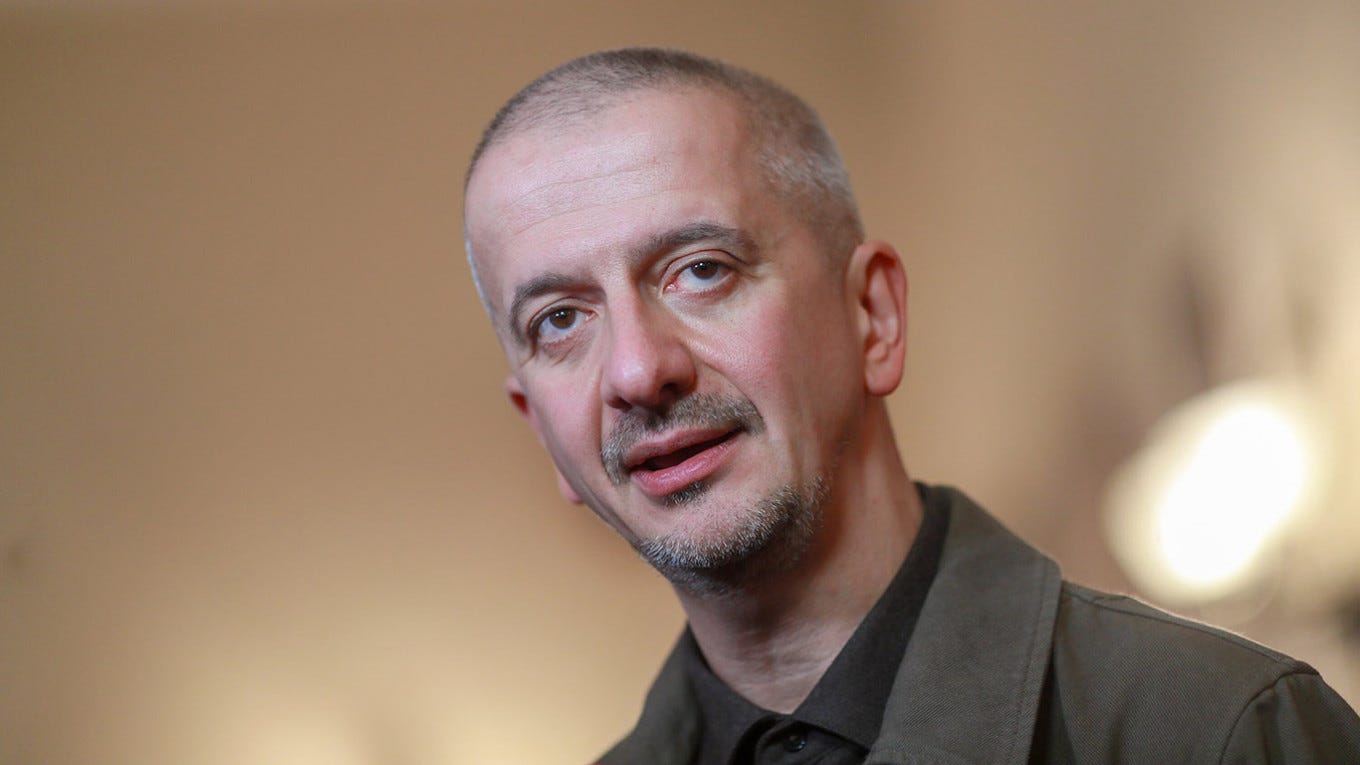
An Ideal Husband was by far and away the best and the most daring of the four productions of Konstantin Bogomolov that I saw. Whatever complaints I had about the length or the inscrutability of its message (“even Russians want to know what’s going on in An Ideal Husband!” Anatoly told us once) I will never get tired of explaining to people that I saw a play that turned into a Twin Peaks homage before the end. Bogomolov was the dominant figure in my first month of theatergoing, and along with Kirill Serebrennikov and Dmitry Krymov, the director whose work I saw the most. Unfortunately, none of his other plays grabbed me.
The very first play I saw in Moscow was Bogomolov’s The Seagull, originally staged for Tabakov’s theater separate from MXAT and featuring Tabakov as Dorn. It was a dull production which only came to life in the final act, when he cast a different actress as Nina for her goodbye scene with Konstantin to emphasize how the two years that pass between Acts III and IV shattered her. His production of Nichola McAuliffe’s Maurice’s Jubilee (retitled Jeweler’s Jubilee) starred Tabakov as a dying jeweler who hallucinates a conversation with Queen Elizabeth at the play’s end. It was less of a great play and more of a great vehicle for Tabakov, who said he chose the role because, as an old man, he wanted to play someone in his last days to prepare himself for the inevitable. But whatever admiration I had for Bogomolov turned to apathy when I saw his five-hour production of The Brothers Karamazov, in which he turned one of my favorite novels into something inert. I walked out after the second intermission – thank God, because the play ran so late that my classmates barely made it back to the dorm before the babushkas at the front desk locked the doors for the evening.3
In the years following my study abroad, the religious right’s social conservatism has influenced what can and can’t appear on Russian stages following the invasion of Ukraine. MXAT has now been reduced to performing “patriotic plays” according to a 2023 article in The Conversation by Russian literature professor Julie Curtis of the University of Oxford – “in other words,” she wrote, “theatre has now been fully instrumentalized by the state in line with its new patriotic cultural policy.” The majority of the directors whose work I studied all live in exile now after they spoke out against the war and had their theaters taken away from them. The exception, unfortunately, is Konstantin Bogomolov.
Once a supporter of Alexei Navalny’s when he ran for Mayor of Moscow in 2013, Bogomolov is now a devoted Putinite. Some of this had to do with his ambitions: After switching his allegiance to Putin, he was appointed head of the Malaya Bronnaya Theater in Moscow, and Putin eventually bestowed him the title of “Honored Artist of Russia.” But Bogomolov’s brownnosing didn’t stop there. In 2021, he wrote a piece for the newspaper Novaya Gazeta called “The Rape of Europe 2.0,” in which he called Western movements such as multiculturalism, feminism and Black Lives Matter “the new ethical Reich.” “The Nazis have given way to an equally aggressive mix of queer activists, fem-fanatics, and eco-psychopaths who have an equally aggressive thirst for the total reformatting of society,” he wrote. He’s now no different from the men who threw Oscar Wilde in prison.
Except for Christian Bale in Empire of the Sun, Kravchenko’s performance in Come and See is the greatest I have ever seen by a child actor. But be warned – this movie will wreck you. Spielberg studied it for Schindler’s List, which should tell you everything you need to know.
Additionally, the play ran afoul of another 2013 law, “the anti-gay law” which forbids the distribution of “propaganda of non-traditional sexual relationships” to children, but the majority of the protests over the play had to do with its take on religion.
Because the Metro stops running between 1:00 and 6:00 a.m., Moscow businesses shut their doors during those hours, which included our dorm.