
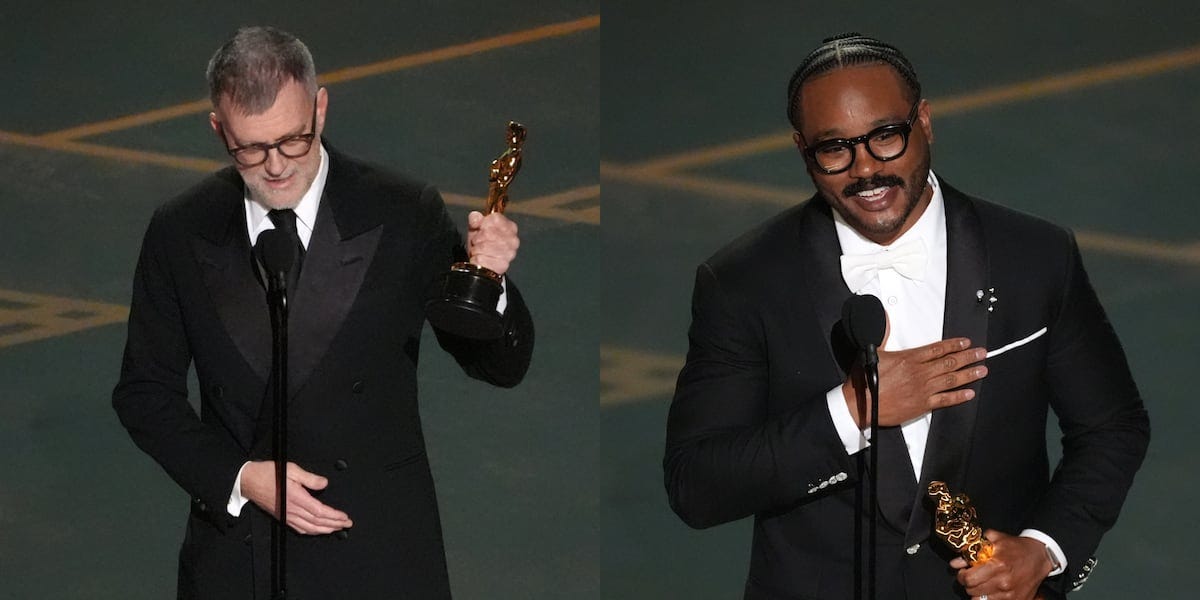
What was hyped up as one of the most suspenseful Best Picture races in recent years turned out to be less than that by the time the 98th Oscars ended. Although Sinners got a surge from its wins at the WGA and the SAG-AFTRA Awards – sorry, “The Actor Awards” – One Battle After Another ultimately won the night, as had long been predicted. Paul Thomas Anderson finally won a long-deserved Best Director Oscar, as well as Best Adapted Screenplay and Best Picture. The film also got awards for Best Editing, Best Casting, and Best Supporting Actor, for Sean Penn’s performance as alt-right Popeye - and who ditched the ceremony, thank God, as there’s nobody worse in front of an Oscar mic.
Meanwhile, Sinners, the most-nominated film in history, won four Oscars, although it was a rough climb. Sinners’ casting director Francine Maisler’s loss early in the evening to One Battle’s Cassandra Kulukandis, one which Maisler was widely expected to win, gave fans a lump in their throat. They could breathe more easily when Ryan Coogler and Ludwig Göransson1 won for Best Original Screenplay and Best Score. Later, Autumn Durald Arkapaw became the first woman ever to win Best Cinematography, and, in the film’s biggest award of the night, Michael B. Jordan won Best Actor, riding a wave of good will from his victory at “The Actor Awards.”
Fans will debate which film should have won for a long time, but having two of the strongest films out of a historically strong Best Picture lineup go head-to-head affirmed that movies still matter, the one nugget of hope to take away from a telecast that returned to the standard dull show after the highs of the 2022 and 2023 awards, and last year’s, the best since Hugh Jackman’s 2008 telecast, which is still considered by many to be the gold standard (get it?) for modern ceremonies. But Conan O’Brien, who was so effortless last year, felt rushed, as if he had a responsibility to bring the show in under three and a half hours lest Adrien Brody gum up the works again. (I’ve still got it!)
Ironically, Brody was one of the few presenters who did well, as everybody else’s jokes were deadly – seriously, reconsider kicking out your old Congressperson and think about kicking out these hacky writers. Once again, the producers decided that the speeches needed cutting above all else, because letting the KPop Demon Hunters producer finish his speech is a sin when you’ve got to get to the next bit. The only non-winner-related moments worth rewatching were the performance of Sinners’ “I Lied to You,” which joins “I’m Still Ken” and “Glory” as one of the best performances of a nominated song in the last 15 years, and the in memoriam, which, with its tributes from Billy Crystal, Rachel McAdams and Barbra Streisand, was the best I have ever seen. (On another note – shut up, these puns are better than any of the jokes last night! – the sound people should be fired too. I could barely hear Streisand.)
But the main story of this year’s Oscars wasn’t the triumph of One Battle After Another, the strength of Sinners, Warner Brothers’ 11 wins, or the horror genre’s 8 wins. The story is how the framework for discussing the Oscars has evolved from “X vs. Y” – with X being the film critics love and Y being the inferior film Hollywood loves – to “stop Y.”
X vs. Y goes back to 1941, when Citizen Kane lost to How Green Was My Valley, but it really took off in 1994 when Pulp Fiction lost to Forrest Gump. That race coincided with the rise of the internet, where Pulp Fiction fans found refuge on message boards both to voice their discontent and debate what was really in the briefcase. The internet played a large role in another X vs. Y race, The Social Network vs. The King’s Speech, in which old folks who couldn’t understand what Jesse Eisenberg was doing when he kept hitting the refresh button at the end of David Fincher’s masterpiece voted for a film about a man equally as frightened of technology as them – in this case, the radio, which many of those voters grew up listening to. Other X vs. Y races include Brokeback Mountain vs. Crash, Moonlight vs. La La Land, and Roma vs. Green Book. In all cases but one, Y triumphed.
This is a reductive framework to talk about movies, even if you’d have voted for X every time, but it creates content and drives traffic. For example, the 2016 Oscars inspired countless articles about “What La La Land Gets Wrong About Jazz” or “Why Moonlight Should Win” and got thousands of clicks. That doesn’t happen in years without a Y: In 2013, the best you could do was have Neil DeGrasse Tyson write a thread about what Gravity got wrong about space.
However, there hasn’t been a true X vs. Y year since Roma vs. Green Book. Yes, people got clicks out of articles excoriating Best Picture nominees Jojo Rabbit, Joker, Don’t Look Up, Maestro, etc. but with the exception of Don’t Look Up, none of these were ever a serious threat to win (and that one only got derailed because its creators wouldn’t stop harassing their critics online.) That leaves people with one option: Find Y and beat up on it.
This is best personified by 2024’s Emilia Pérez, the most vilified Oscar contender since Green Book. For fans, this trans-narco-musical was an X for its tonal balancing act; for haters, it was Y because of…well, everything. Dozens of articles were written in defense or condemnation, but by the time it got 13 nominations, it seemed all but unstoppable. It wasn’t until journalists discovered star Karla Sofía Gascón’s racist tweets that the film got knocked off its pedestal, as her bigotry generated entertainment news cycles and drove traffic.
This race signified that “find Y” was here to stay, because there was never an attempt to find X. This isn’t to say Anora didn’t fit the bill for X – auteur-driven indies (even ones by people with problematic Twitter histories) almost always do – but nobody ever went in framing the race as Anora vs. Emilia Pérez. It was just “stop Emilia Pérez.” And even as a hardcore Emilia Pérez hater, I regret that the discussion has gotten to this place because the search for a villain is tiresome, reductive, and in some cases, all too revealing.
Although the 2025 race turned into X vs. X by the time the nominations came out, it didn’t start out that way. In the months prior to the nominations, film critics and influencers worked overtime to take down other films. There was a month of “Train Dreams Discourse,” in which people insisting that director Clint Bentley and co-writer Greg Kwedar’s adaptation sacrificed that book’s complexities into something more palatable. There was Noah Baumbach’s Jay Kelly, which seesawed between indifference and praise with every festival it played to the point where you had no idea where the consensus lay. Ultimately, people decided that Marty Supreme and its star, Timothée Chalamet, were the final bosses, with Timothée’s try-hard campaign and his comments about opera and ballet giving him 15 minutes of shame.
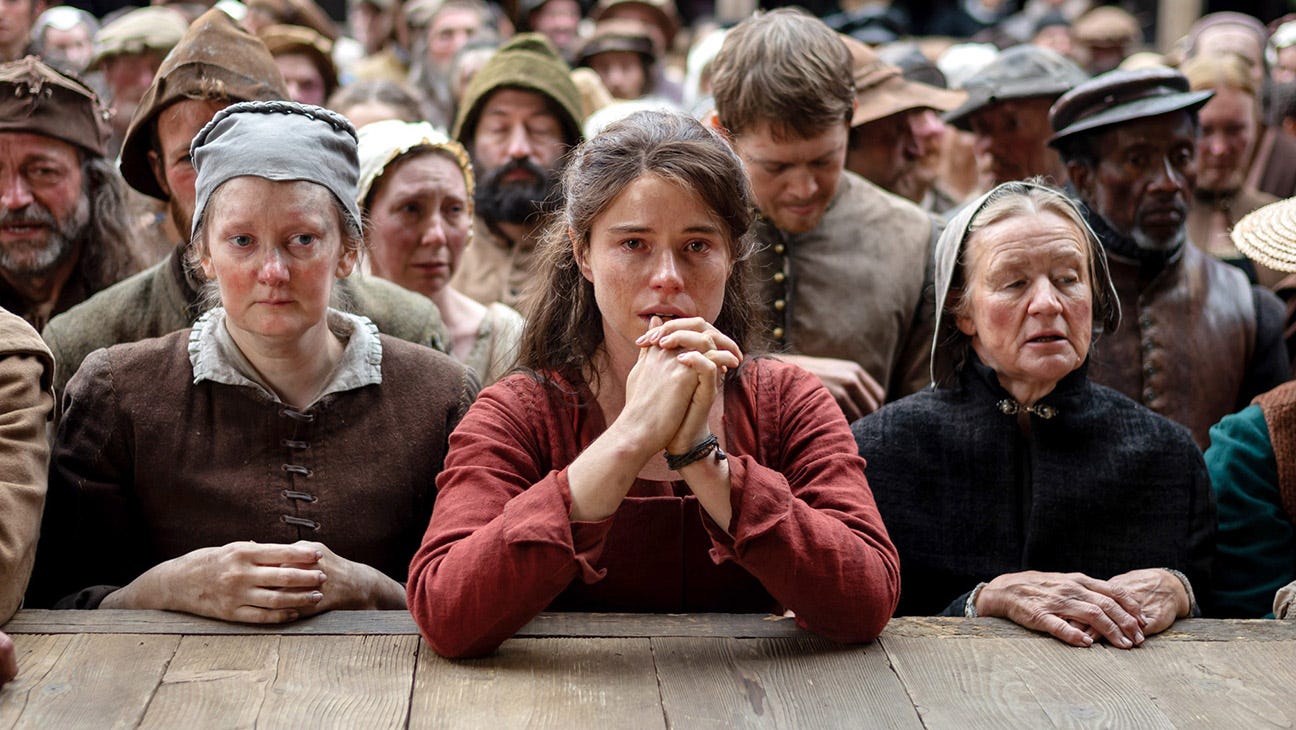
But the most disgraceful “find Y” campaign this year was the takedown of Chloé Zhao’s Hamnet, my choice for the year’s best film. As a theater nerd, a huge fan of Maggie O’Farrell’s book, and a new dad, I sensed it would be my favorite going into this Oscar season, but Zhao’s film transcended the novel with its third act, in which Agnes sees Hamlet for herself. I’ve seen critics argue that Zhao and O’Farrell’s interpretation of the play reduces its power, but I have always agreed with Ray Bradbury that the animating force behind Hamlet as a character is “my father is dead and I hate it, but how can I bring him back?” Hamnet’s genius is not just to tie the play’s creation to Will’s grief, but when everyone in the audience reaches towards the dying Hamlet, you realize that they have all lost someone they love to the plague, and Will has allowed them all to channel their own grief through his work.
It was deeply insulting to read the writings of so many men who dismissed Hamnet as grief porn, or refused to see it, or gave it zero stars and described it as “misery porn” as Film Freak Central’s Walter Chaw did in a review that said nothing about the film and everything about his mommy issues. Yes, there were some good-faith critiques of Hamnet, such as Christy Lemire’s mixed take for Rogerebert.com, but those were few and far between. Men who believed they owned the ability to interpret Hamlet, or refused to engage with a work made by a woman, vilified Hamnet to the point that by the time it won its Golden Globe for Best Drama, it was fated to be an also-ran.
Perhaps I am giving too much power to the haters, and Sinners and One Battle After Another were fated to be the top contenders from the get-go. I have no problem with that. But having endured an agonizing six months of “find Y,” and with less than six months to go until Venice and Telluride kick things off for next year, I’m dreading what this fall will bring. Last week I quoted set designer Boris Aronson, who said there are two rules of theater: one, in every production there is a victim, and two, don’t be the victim. If he were alive today, he would agree that the Oscars—and for that matter, all of social media—now operates under two similar principles: one, every year there’s a villain, and two, don’t be the villain. And if from now on, every contender has to waste valuable time threat modeling against takedown campaigns, then we’re all screwed.
Fun fact: Ludwig Göransson scored the pilot for my Mom’s TV show Red Band Society. He is just as cool - and as kind - as you expect.
Love this framing. It's true that some of the stuff I spoke about in my piece, especially stan culture, has transformed the race into a film that "must be stopped" as you put it. Great work!