
Sergei Loznita’s adaptation of Georgy Demidov’s novella Two Prosecutors depicts the Soviet Union’s Kafkaesque legal system, one which shot first and asked questions later. In 1937, the year the film is set, Josef Stalin and the NKVD were approving kill lists without consideration as to who or why, sometimes as many as 1300 in one day. Writer Lidiya Chukovskaya, who lost her husband in these purges, wrote of the fruitlessness of interpreting these decisions, saying: “If you let it sink in…that they were doing it ‘just because,’ that killers killed just because it is their job to kill, then your heart, though no bullet has pierced it, will be torn apart, and your mind, in its intact shell of a head, will grow shaky.”
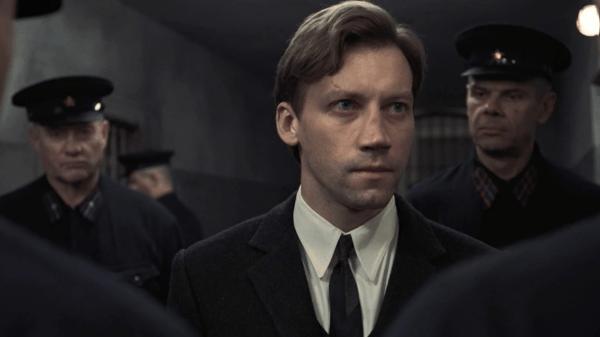
Kornyev, a Soviet prosecutor played by Aleksandr Kuznetsov, is summoned to a prison outside of Moscow after receiving a note written in blood from Ivan Stepniak, whom he recognizes from a speech he gave at Kornyev’s law school’s Jubilee Day. Loznitsa makes a gutsy decision (by the standard of American storytelling at least) to let Kornyev’s visit to the prison play out in real time. For one hour, with barely any camera movements and no music, we see Kornyev work his way past guards seeking to stop him until he reaches Stepniak’s cell.
Played by Aleksandr Filippenko, Stepniak is a broken old man who took part in the Bolshevik Revolution but whom the NKVD has left to rot for his refusal to name names. Filippenko’s tour de force performance is highlighted by a nearly 10-minute monologue in which he shows off his scars as bodily proof of the damage the system has inflicted not just on him, but on thousands of others who once considered themselves true believers. “Honest, knowledgable experts are substituted by ignorant charlatans,” he tells Kornyev, begging him to bring his case before prosecutors in Moscow. “You insisted on a meeting with me, so they won’t leave you in peace. Before you know it, you yourself will end up in a hole like this one.”
The “ignorant charlatans” Stepniak describes are all depicted as men trying to do their job just as earnestly as Kornyev tries to do his. Throughout the film, none of the state’s employees even so much as raise their voices. Many of them are as bored going through their routines as the pilots under Major Kong’s command in Dr. Strangelove, always playing cards or guzzling down coffee to get through what is to them just another day at the office. It’s not so much the banality of evil that Loznitsa is after as much as the boredom.
This can make Two Prosecutors feel slow. The austere camerawork and lack of non-diagetic music continues into the film’s second half, in which Kornyev returns to Moscow to meet with a general prosecutor about Stepniak’s case. A great deal of screen time is spent watching Kornyev in the waiting room as he bides his time before his meeting. But Loznitsa’s style purposely grounds the viewer in the monotony of autocracy. To an observer, autocracy is thrilling—to paraphrase Mark Zuckerberg, they move fast and break things. But for those who have to live in it, autocracy slows down everything it touches, reducing daily life to an unending grind. And by the time Loznitsa reaches his conclusion, he’s fulfilled Stepinak’s warning: All fall prey to the system’s machinations. Watching it, I was reminded of a poem by Naum Korzhavin, about a woman who complied with the NKVD but found herself in the Gulag anyway:
“The work of the Party is sacred, no room for emotions.
Stick to the substance.
Discard everything else.”
Two Prosecutors goes into wide release today.