

Everywhere I turn, I see Democrats arguing about whether or not they should embrace far-left personality Hasan Piker following Michigan Senate candidate Abdul El-Sayed’s decision to campaign with him at an event this month. If you are one of the 55% of Democrats who haven’t heard of him (and I envy you), Piker is a Twitch streamer who has made millions through his 10-12 hour daily streams where he rants about how great socialism is and how lame Democrats are, while occasionally doing animal abuse. If Kamala Harris had won the 2024 election, he would probably remain on the fringe, but instead, some want to make him the Democratic Party’s Joe Rogan, given that he’s a young(ish) White man - a long-sought-after demographic - and can maybe bring people around to progressive issues like Gaza.
In case you can’t tell, I don’t like this guy—which is why I’ve avoided writing about him. I started out as a journalist writing snarky pieces taking down far left gadflies, and I’ve outgrown it because there’s only so many ways you can get a thousand words out of “this person sucks and their arguments do too.” So in the interest of my readers, and my sanity, I haven’t written anything about Hasan Piker.
And then I saw this clip from a Yale Debate Society event this week in which Piker uses near-identical language to Vladimir Putin to describe the collapse of the USSR:

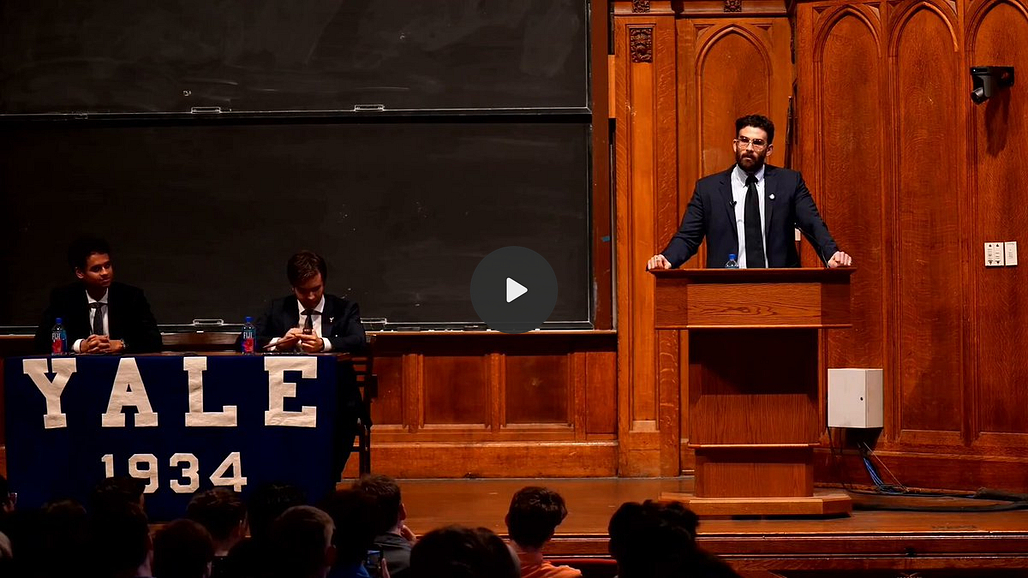
Please forgive that the above tweet comes from the RNC, who would love nothing more than to tie the entire Democratic Party to Communists because there are some parts of this country where that works (namely the one that starts with “Flor” and ends with “ida”). Before you kill the messenger, know that this isn’t the first time Piker has said this. Here he is at Zohran Mamdani’s election night party not six months ago:


Since writing these articles, I’ve been devouring books on the Soviet Union1—mostly while my seven-month-old son sleeps on me—and in that time I’ve come to radical conclusion that the Soviet Union was bad. Not that you need reminding of that, but maybe you do, because the further it recedes from living memory, the more likely people think it couldn’t have been all that bad (much the way people argue about the Nazis today) and that its collapse was indeed terrible for Eastern Europe. “If a dictatorship is inevitable,” Piker said earlier that evening, “I’d rather have it be a dictatorship of the proletariat.” Well that’s exactly what the Soviet Union was, Hasan. And again—I cannot stress this enough—it was bad.
The difference between right-wing and left-wing dictatorships is that far-right dictators believe that societies suffer from too much freedom, as Mussolini argued in “The Doctrine of Fascism,” while left-wing dictators believe that the working class must be freed so that the state can institute policies that level the playing field. Vladimir Lenin obtained power and a strong following because the tired, poor huddled masses believed his argument that imposing Marxist principles on the country would bring new freedoms stemming from collectivism and reducing class and sexual inequality.
Of course, the actual outcome of Lenin’s policies resulted in the same hallmarks of right-wing authoritarianism: suppression of free speech, mass purges, the takeover of adjoining nations, and a scarcity of resources that furthered income inequality. Alexei Navalny writes in his memoir, Patriot, about having to wake up early to get on the breadline so his family would have something to eat. Know who never had to stand on a breadline? Stalin.
That not enough, Hasan? Let’s take a look at some numbers:
3.9 million—Number of people who died in the Holdomor, a genocide in Ukraine during which Stalin starved the farmers who populated the rural countryside. (Actual number probably higher.)
486—Maximum number of Gulags, the Soviet prison system established under Stalin’s reign which lasted until the early 1950s.
1.6 million—Estimated number of people who died in the Gulags between 1930 and 1956. (Actual number probably higher.)
1 million—Number of people killed during Stalin’s first Great Purge between 1937-38 out of the 7 million arrested.
14—Number of Eastern European states the Soviet Union took over in its 73-year existence.
And that’s to say nothing of the stifling of Russian artists and art, which flourished in the 19th century and even into the early years of the Soviet Union before socialist realism got imposed. Hasan Piker has never struck me as someone who cares about theater, so he probably isn’t interested in learning about the execution of Meyerhold, the censorship of Mikhail Bulgakov, the murder of Jewish stage actor Solomon Mikhoels and the forced shutdown of Alexander Tairov’s theater. But he doesn’t need to take a class on this—or read my essays—to understand how bad the suppression of artistic freedom was. All he needs to do is watch Battleship Potemkin, Man with a Movie Camera or any classic of early Soviet cinema and then compare it to The Fall of Berlin, the 1950 film in which Josef Stalin reunites two young lovers.2 Free societies don’t greenlight movies like that.
But there’s a larger problem with Piker’s statement, which isn’t just the fact that, again, Putin said basically the same thing—it’s that Piker has no problem praising dictatorships with left-wing roots. This past year he’s been to both China and Cuba, and said nothing but good things about both while downplaying or outright ignoring their gross human rights atrocities, including the Uyghur genocide, and praising leaders like Mao Zedong, who killed millions through famine and purges. Jeremiah D. Johnson did an excellent job collecting many of these incidents in a persuasive Twitter thread, so rather than restate what he did, I invite you to read it for yourself:


Democrats should run from Hasan Piker not because he has made antisemitic or sexist comments but because he does not see democracy itself as worth defending. Those who hyper-focus on the failures of the United States, particularly in post-WWII foreign affairs, often find themselves excusing dictatorships because if the U.S. is the bully, then Cuba, China or Russia must be victims. The answer to this ahistorical myopia is not shallow patriotism but a nuanced view of this nation as one that represents both the generosity and the cruelty of human nature. And it sure doesn’t include any revisionism of the Soviet Union.
Just in the last month I’ve read The Future Is History: How Totalitarianism Reclaimed Russia by M. Gessen, Motherland by Julia Ioffe, and Alexei Navalny’s memoir, Patriot. I highly recommend all of them.
This is a real movie. I have seen it. It is bad.